Toddler Mouth Sores: Pictures, Causes, and When to Call the Pediatrician

Reader-supported. We may earn a commission from links on this page. Advertising disclosure.
In this article
Spotting a sore in your toddler’s mouth is unsettling, especially at 2 a.m. when no office is open. The good news: most toddler mouth sores come from one of five common causes and clear up on their own within one to two weeks. This guide walks you through pictures of each, the signs that point to one condition over another, and a clear list of when to call your pediatrician.
Call 911 or go to the emergency room if your toddler has:
- Trouble breathing, retractions (skin pulling in at the neck or ribs), or blue or gray lips, tongue, or face3,26
- Rapidly worsening swelling of the face, jaw, or neck3,29
- Severe weakness, limpness, or trouble waking26
- Signs of severe dehydration — no urine for more than 8 hours, no tears, very dry mouth, or refusal to drink for more than 8 hours23,24
Call the pediatrician immediately if your child is 3 months or younger with a rectal temperature of 100.4°F (38°C) or higher — even without other symptoms. Don’t wait for a same-day appointment.25
Call the pediatrician the same day if: mouth ulcers are spreading or last longer than two weeks; pain is bad enough that your child won’t drink; a white or yellow mouth patch is hard to wipe away, or wipes off and leaves the tissue underneath red or raw; or you suspect a first cold-sore (HSV-1) outbreak — especially in the first three days, or alongside fever, swollen gums, heavy drooling, open lip sores, severe pain, or drinking less than usual.8,11,16
What Toddler Mouth Sores Usually Are
Common causes of toddler mouth sores include hand-foot-and-mouth disease (HFMD), herpangina, primary herpetic gingivostomatitis (a first cold-sore outbreak), canker sores, and oral thrush.11,19 Each looks different and lives in a different part of the mouth — which is why pictures are so useful.
The five differ mostly in three ways: where the sores show up, whether there are signs on the rest of the body, and whether they’re contagious. Use this page to narrow the field, then loop in your pediatrician or pediatric dentist for the diagnosis. For background, see our adult mouth-sores guide.
Toddler Mouth Sores Pictures: Five Common Causes
Each section below has an educational medical illustration, a short caption, what to look for, and a link to a deep-dive page when one exists on NewMouth.
Hand-Foot-and-Mouth Disease (HFMD)
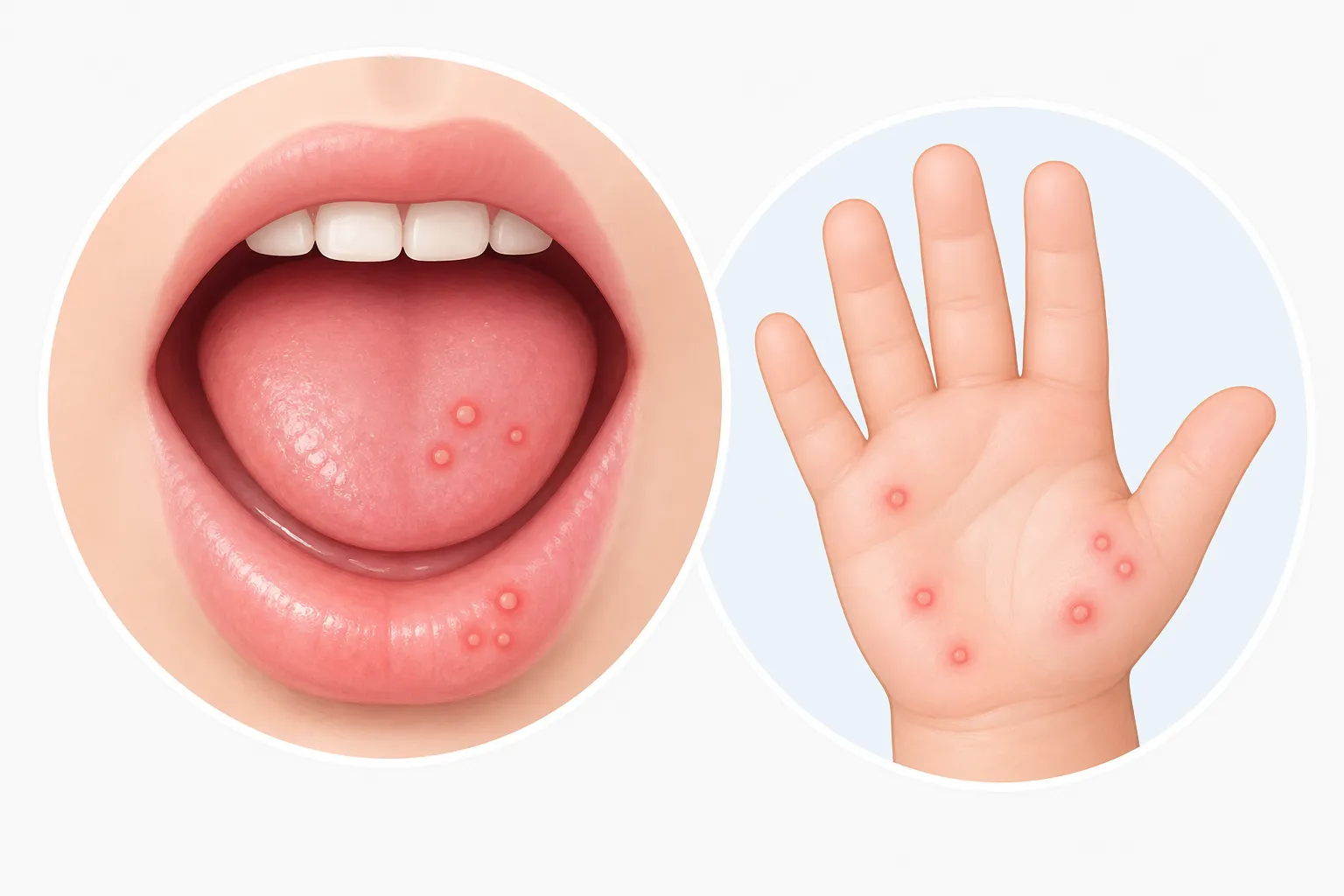 HFMD: small ulcers in the front of the mouth plus red spots or blisters on the palms, soles, or buttocks. Contagious.
HFMD is a viral illness most often caused by coxsackieviruses such as A16 or A6, with enterovirus A71 sometimes responsible during outbreaks.3 It’s most common in children younger than 5 and peaks in summer and fall in the U.S.1 The defining pattern is mouth sores plus a rash or small blisters on the palms, soles, and sometimes the buttocks and legs.2,4
Children are most contagious during the first week of illness, and the virus keeps shedding in stool for weeks afterward — which is why handwashing after diaper changes matters.4,1 Symptoms usually improve within about a week.2 A dedicated HFMD deep-dive is on the NewMouth roadmap; in the meantime, the CDC HFMD page has the full picture.
Herpangina
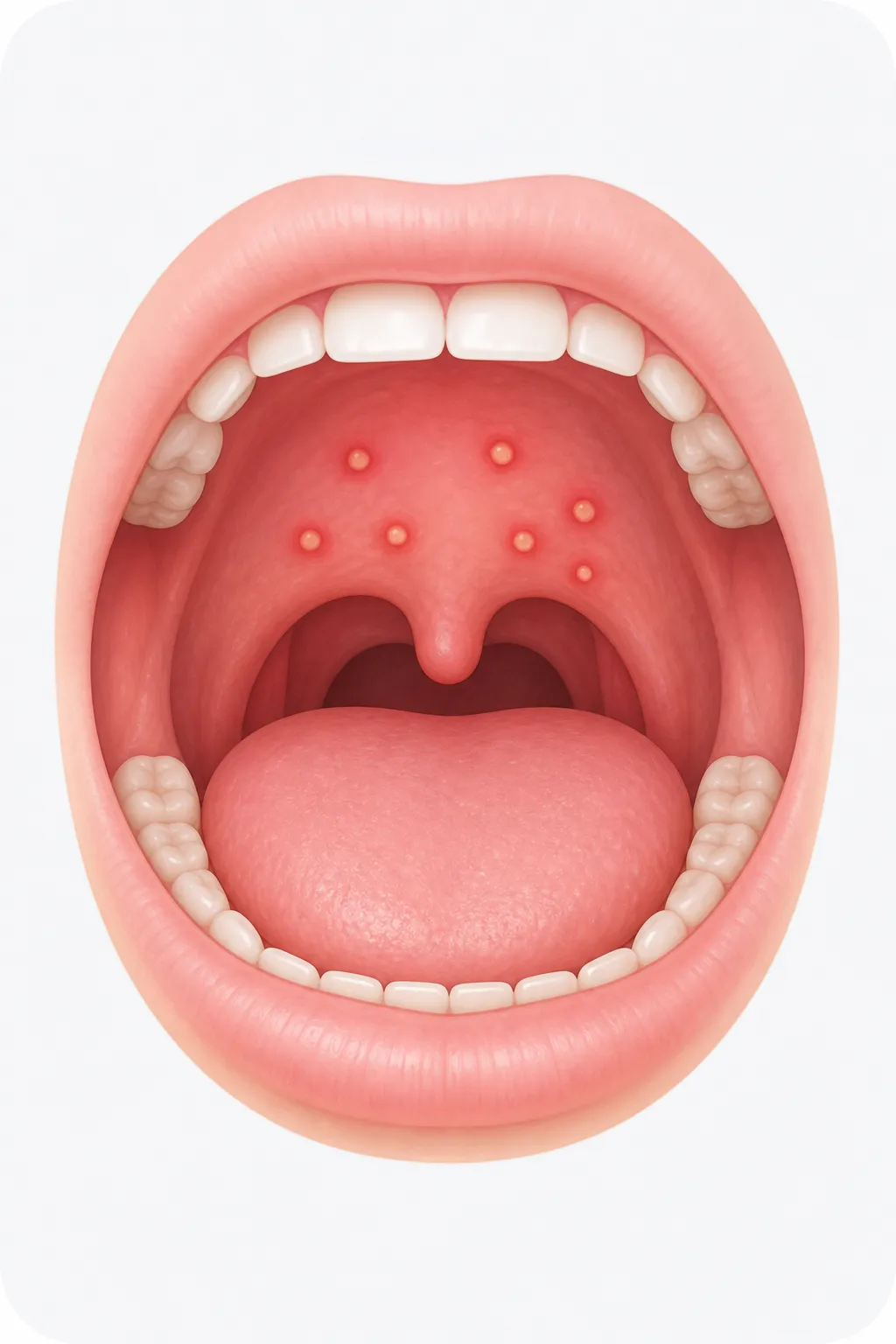 Herpangina: small ulcers concentrated at the back of the mouth — soft palate, tonsils, and posterior throat. No rash on hands or feet. Contagious.
Herpangina is a viral throat infection in the same enterovirus family as HFMD, including coxsackie A, coxsackie B, and EV-A71.5,6 The giveaway is location: ulcers cluster at the back of the mouth — soft palate, tonsils, and posterior pharynx — and the hands and feet stay clear.6 A rash on the palms or soles points toward HFMD instead.2
Herpangina affects toddlers and young children, with symptoms usually improving within about a week.5,6 Expect fever, sore throat, a drop in appetite, and drooling because swallowing hurts. Hydration is the main job at home.
Primary Herpetic Gingivostomatitis (First Cold-Sore Outbreak)
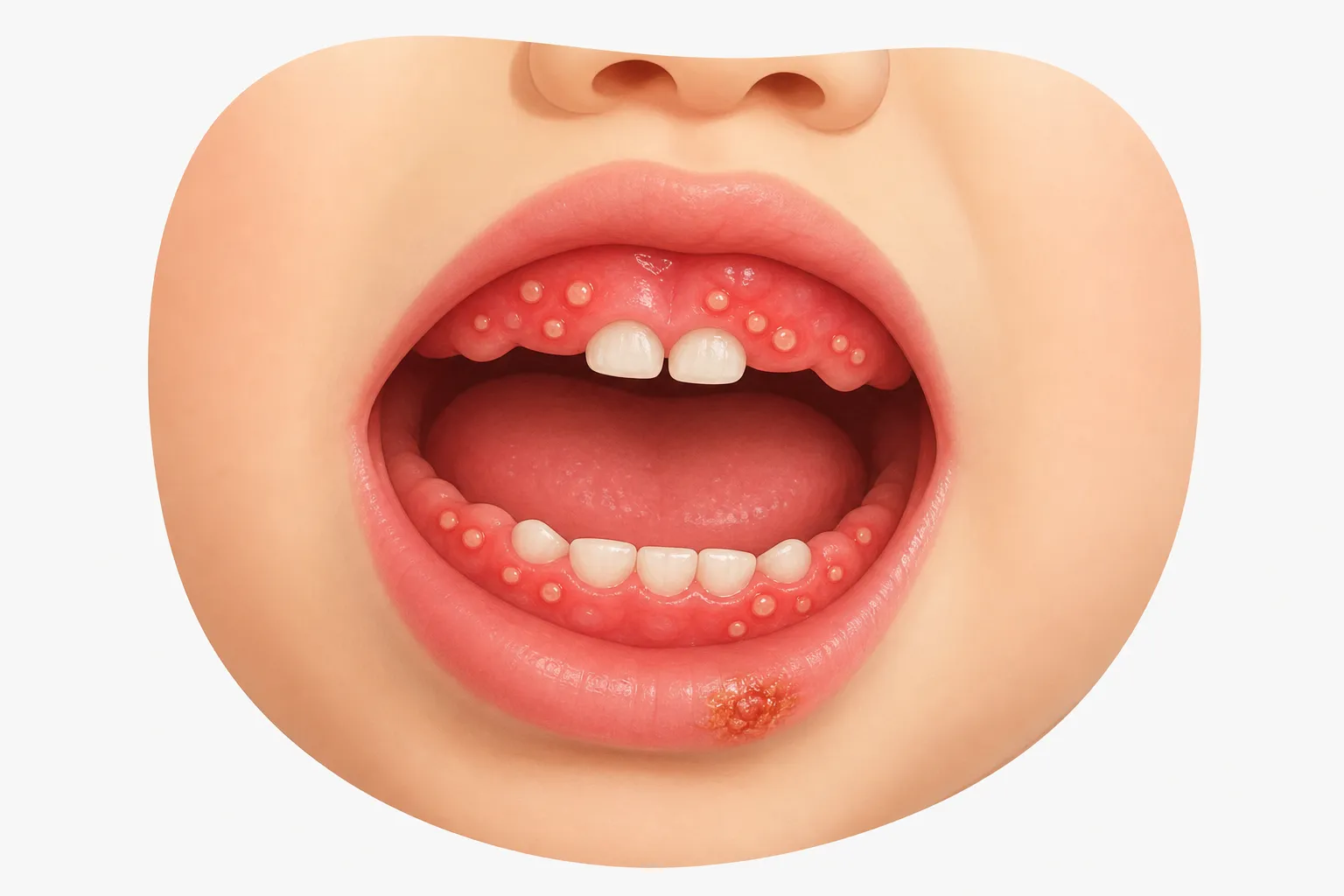 Primary herpetic gingivostomatitis: clustered ulcers on the gums, tongue, and lips with swollen, beefy-red gums. Often the first sign of HSV-1. Contagious through saliva.
This is a child’s first run-in with herpes simplex virus type 1 (HSV-1) — the same virus that causes adult cold sores.7,8 It typically shows up between 6 months and 5 years.7 The look is dramatic: clustered ulcers across the gums, tongue, inside the lips, and sometimes the outer lip, paired with red, swollen gums and a high fever. This first outbreak often looks more alarming than the recurring cold sores adults get later on.8
Most cases improve in one to two weeks, though some take longer.19 The virus spreads through saliva and skin contact, so kissing, shared cups, and shared utensils all transmit it.8,9 Hydration is the priority — the gums hurt enough that drinking becomes a battle — and call the pediatrician the same day, especially in the first three days of symptoms or if your child is drinking less than usual. For related reading, see our stomatitis and cold sores guides.
Canker Sores (Aphthous Ulcers)
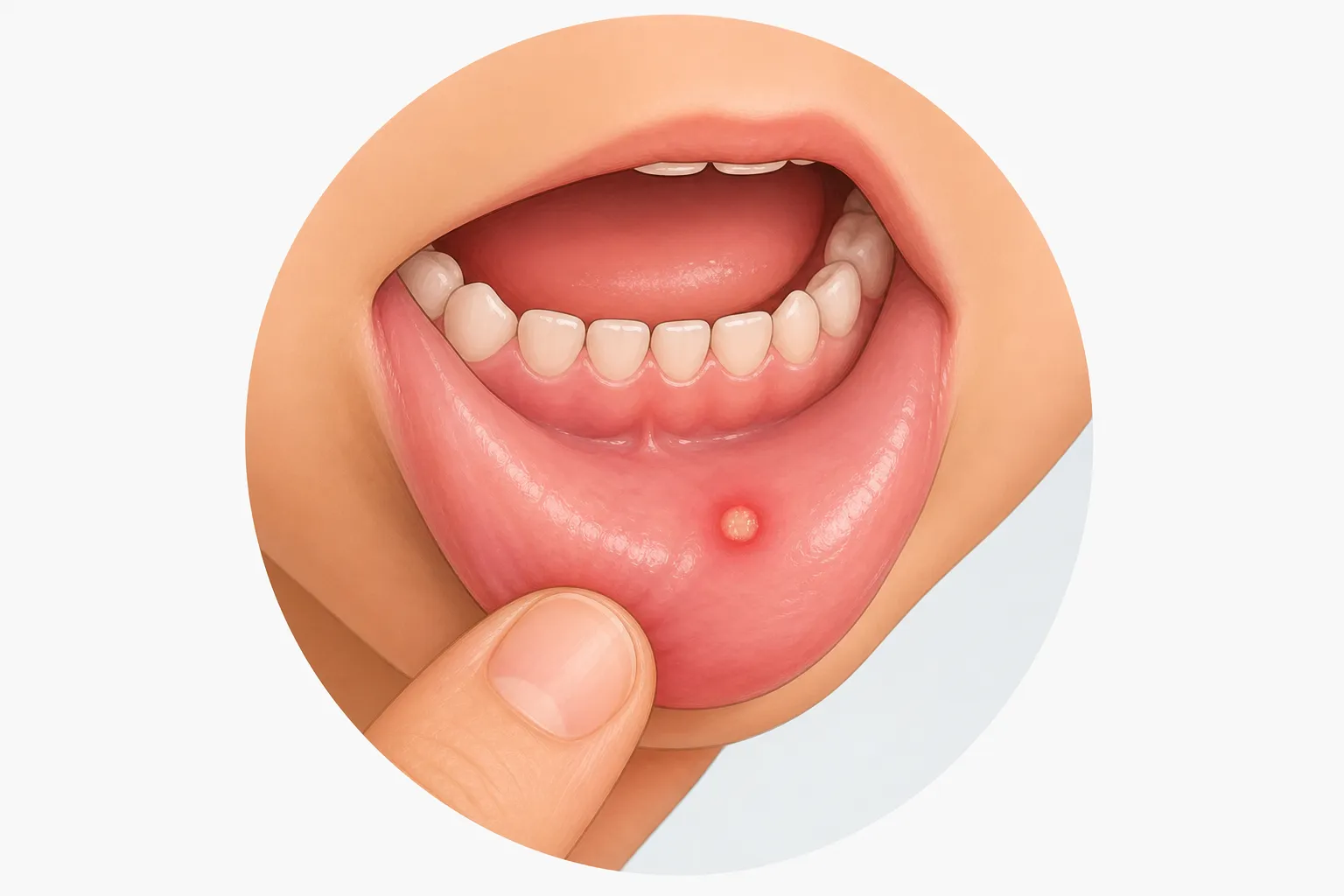 Canker sores: round or oval ulcers with a white or yellow center and a red border, on the inside of the cheek, lip, or tongue. Not contagious.
Canker sores are small round or oval ulcers with a white or yellow center and a red border. They usually show up on the soft, movable lining of the mouth — inside the cheeks or lips, on or under the tongue, the floor of the mouth, and sometimes near the base of the gums — not on the firm, attached gums or the hard palate.10,11 They are not contagious. Triggers include minor mouth trauma, certain foods, and immune or nutritional factors.10,12
Canker sores are less typical in very young toddlers and more common around school age.11,12 They heal on their own in 7 to 14 days.12 Comfort care — soft cold foods and avoiding salty or acidic triggers — is usually enough. See our canker sores guide for the full breakdown.
Oral Thrush (Oral Candidiasis)
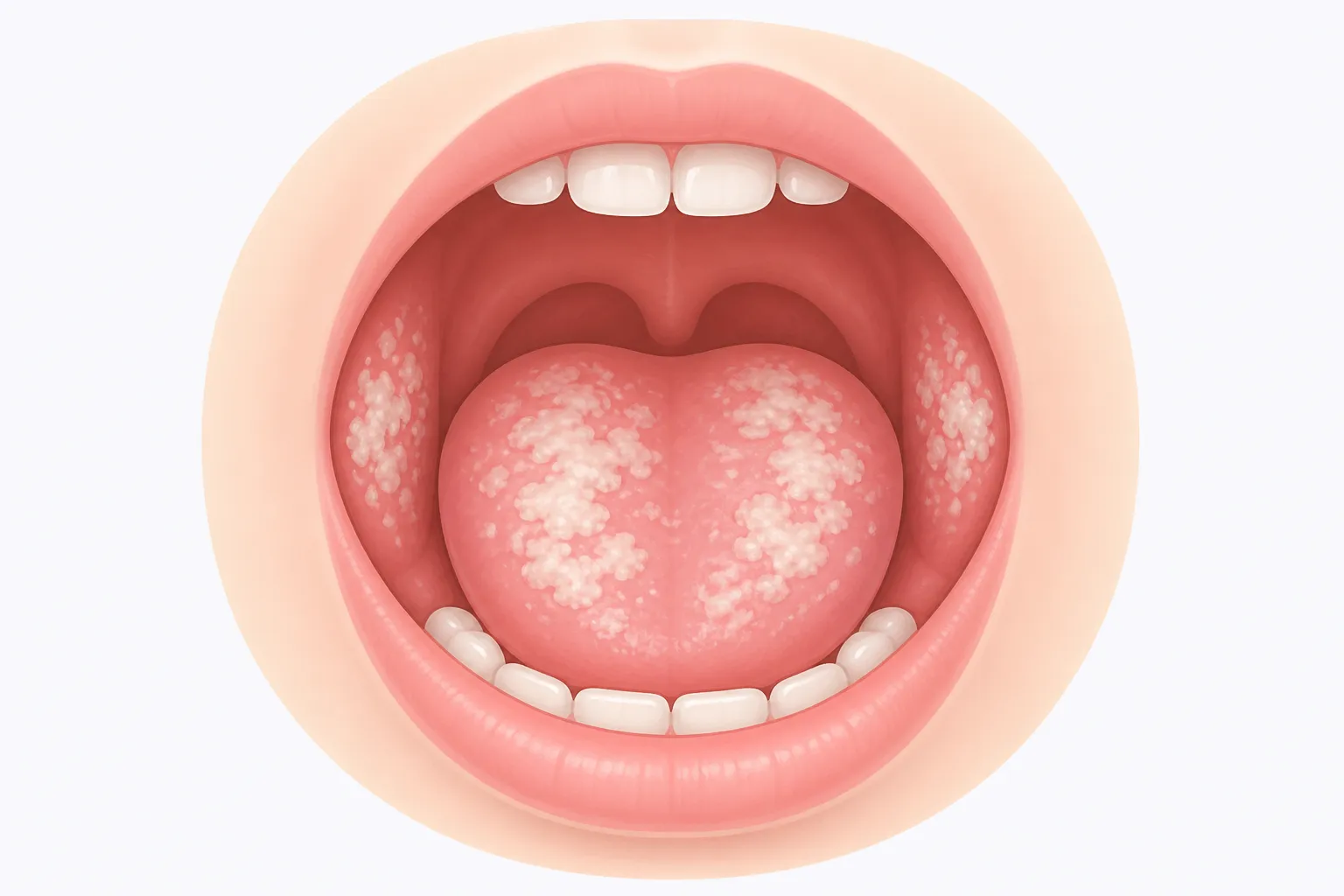 Oral thrush: creamy white or yellow patches on the tongue, inner cheeks, gums, or roof of the mouth that are hard to wipe away — or that wipe off and leave the tissue underneath red or raw — unlike milk residue, which wipes off cleanly.
Oral thrush is a yeast infection caused by an overgrowth of Candida albicans.13,18 The look is creamy white or yellow patches on the tongue, inner cheeks, gums, or roof of the mouth.14,16 The wipe-off check is the simplest at-home test: milk residue wipes away cleanly with a soft cloth, while thrush patches are harder to remove, and the tissue underneath can look red or raw.16
Thrush is most common in babies but shows up in toddlers, especially after antibiotics or while using an inhaled steroid for asthma.17,18 If thrush keeps coming back or appears in a child older than 2 to 3 years without a clear trigger, ask the pediatrician whether an underlying cause needs to be checked.18 Treatment needs a pediatrician — a prescription antifungal clears it.15,17 Thrush is not spread like HFMD or HSV, but yeast can pass between a breastfeeding parent and infant.18
What It Is Not: Quick Distinctions
A few normal toddler events look enough like mouth sores to send parents searching:
- Teething irritation — Drooling, gum chewing, and mild gum discomfort are typical with teething. A real fever, diarrhea, or unusual fussiness should not be chalked up to teething alone.20,21 See the teething rash guide if the irritation extends to the chin.
- Eruption cysts — A soft bluish or dark bump on the gum over an erupting tooth is often an eruption cyst, not a sore.19 They resolve on their own as the tooth comes in.
- Geographic tongue — Map-like shifting red patches on the tongue with white borders look striking but are harmless.22 See our geographic tongue page for what it looks like.
- Trauma from a fall or bite — A single sore where a toddler chomped on their cheek or hit their lip is usually a shallow contusion that heals in a few days.
- Milk or formula residue — Whitish patches that wipe off easily with a soft wet cloth and leave healthy pink tissue underneath are milk, not thrush.16
How to Tell Them Apart at a Glance
The table below puts the five conditions side by side. Use it as a quick reference after the illustrations above.
| Condition | Where in the mouth | Hallmark look | Other body signs | Typical age | Contagious |
|---|---|---|---|---|---|
| HFMD | Front of mouth, tongue, inside cheeks and lips | Small ulcers plus rash on palms, soles, or buttocks2 | Rash on hands, feet, sometimes buttocks or legs; fever2 | Under 5; peaks summer–fall1 | Yes — saliva, stool, contact4 |
| Herpangina | Back of mouth: soft palate, tonsils, throat | Small ulcers concentrated at the back; no hand/foot rash6 | High fever, sore throat, drooling | Toddlers and children under 105,6 | Yes — saliva, stool, droplets5 |
| Primary herpetic gingivostomatitis | Gums, tongue, inside lips, sometimes outer lip | Clustered ulcers with red, swollen gums; high fever7,8 | High fever, irritability, drooling, swollen lymph nodes | Often 6 months to 5 years7 | Yes — saliva, skin contact8,9 |
| Canker sores | Inside cheeks, lips, on or under tongue, floor of mouth; sometimes base of gums — not firm attached gums or hard palate | One or a few round ulcers with white-yellow center, red border10 | None typical | Less typical under 2; more common in older children11,12 | No10 |
| Oral thrush | Tongue, inner cheeks, gums, roof of mouth | Creamy white or yellow patches that are hard to wipe off, or wipe off and leave red, raw tissue16 | Fussy feeding; sometimes a related diaper rash | Most common in infants; can occur in toddlers18 | Low daycare risk; can pass between nursing parent and infant18 |
Home Care for Toddler Mouth Sores
For most viral and aphthous mouth sores, the home job is pain control, hydration, and patience. Dehydration is the most common reason a routine case turns into a same-day pediatrician call.
Hydration is the top priority. Mouth sores make swallowing painful, which leads to dehydration quickly in a small child. Offer cold fluids in small, frequent sips:
- Cold water, cold milk, or diluted cold juice
- Plain popsicles, frozen yogurt tubes, or smoothies through a straw
- Cool applesauce, yogurt, mashed banana, scrambled egg, or oatmeal
- Plain pasta, soft rice, or mashed potatoes once swallowing improves4
Foods to skip while sores are healing:
- Citrus fruits and juices (acidic and stinging)
- Salty or spicy foods
- Crunchy foods that scrape sore tissue
- Very hot foods or drinks4
Pain relief. The AAP supports acetaminophen or ibuprofen at the dose your pediatrician recommends for your child’s weight and age — never aspirin in children, and check with the pediatrician before giving ibuprofen to a child under 6 months.4,20
Oral hygiene. Keep brushing gently with a soft brush, but skip it if the gums are too tender — a swish with plain water after eating works as a stand-in. Skip regular mouthwashes or anything that stings unless your pediatrician recommends it.4
When to Call the Pediatrician
Calling can feel like overreacting, but pediatricians hear from worried parents every day — a quick phone call beats waiting too long. Here is a tiered checklist drawn from AAP triage guidance.11,23,26
Go to the ER or call 911:
- Trouble breathing, retractions, or blue or gray lips, tongue, or face3,26
- Severe weakness, limpness, or trouble waking26
- Rapidly worsening facial, jaw, or neck swelling3,29
- Severe dehydration: no urine for more than 8 hours, no tears, very dry mouth, sunken eyes, or refusal to drink for more than 8 hours23,24
Call the pediatrician immediately:
- A child 3 months or younger with a rectal temperature of 100.4°F (38°C) or higher — even with no other symptoms25
Call the pediatrician the same day:
- Pain bad enough that your child refuses fluids for more than a few hours23
- Mouth ulcers that are spreading, very large, or that wrap onto the outer lip11
- A white or yellow mouth patch that won’t wipe away cleanly, or that wipes off and leaves red or raw tissue underneath (likely thrush)15,16
- A suspected first cold-sore (HSV-1) outbreak — especially in the first three days of symptoms, or alongside fever, swollen gums, heavy drooling, open lip sores, severe pain, or drinking less than usual8
- High fever lasting more than 2 days alongside mouth sores11
Call the pediatrician within a day or two:
- Mouth ulcers that have not started to improve after a week11
- Recurring canker sores that interrupt eating or sleep11
- You’re not sure what you’re looking at and want a professional opinion
Watchful waiting is reasonable when: ulcers are small, your child is drinking, fever is mild and improving, and the pattern matches one of the five conditions above.
Contagion and Day Care: When Can They Go Back?
Day-care return rules vary by state and individual facility, and many programs are stricter than the CDC and AAP minimums. Use the following as the floor, then check your day care’s policy.
- HFMD: Children return when they are fever-free, well enough to participate, and no longer drooling uncontrollably from mouth pain. The CDC notes that open blisters are especially contagious — check your day care for additional rules.1,27
- Herpangina: Same general standard as other enterovirus illnesses — fever-free, well enough to participate, and able to swallow without heavy drooling.5,27
- Primary herpetic gingivostomatitis: Many children with cold sores attend day care once they feel well, and the AAP does not support a blanket “stay home until lesions crust” rule. A first outbreak with heavy drooling, open lip sores, or fever usually means staying home until the pediatrician gives the OK.8,27
- Canker sores: Not contagious — no exclusion needed.10,27
- Oral thrush: Children with thrush generally attend child care while being treated, but confirm with the pediatrician and the day care.16,18
Open blisters, fever, and uncontrolled drooling are the three signs day cares flag most, regardless of the underlying cause.
Preventing Toddler Mouth Sores
You cannot prevent every mouth sore, but a few habits cut down on the contagious ones.
- Handwashing — Wash hands with soap and water for at least 20 seconds after diaper changes, after wiping noses, before meals, and after the bathroom. This is the most useful single hygiene step against HFMD and herpangina.28
- No sharing of utensils, cups, or pacifiers between children, and not between caregivers and children when cold sores are active. HSV-1 spreads easily this way.8,9
- Sanitize pacifiers and bottle nipples by washing in hot soapy water or running them through the dishwasher, especially while treating thrush.17
- Clean toys that go in mouths during HFMD or herpangina outbreaks at day care.27
- Gentle daily oral care — a soft brush twice a day with a smear of fluoride toothpaste (grain-of-rice for under 3, pea-sized for ages 3 to 6) supports oral health and makes early changes in the mouth easier to spot.
Frequently Asked Questions
What Do Mouth Sores in Toddlers Look Like?
Each cause has a distinct look. HFMD produces small ulcers in the front of the mouth paired with a rash on the palms, soles, or buttocks.2 Herpangina concentrates ulcers at the back of the mouth — soft palate and throat — with no hand-or-foot rash.6 A first HSV-1 outbreak brings clustered ulcers across the gums, tongue, and inner lips with red, swollen gums and high fever.7,8 Canker sores are round ulcers with a white or yellow center and a red border on the inner cheeks, lips, or tongue.10 Thrush shows as creamy white or yellow patches that are hard to wipe away or wipe off leaving red or raw tissue.16 The photos in this guide show each one side by side.
How Long Do Toddler Mouth Sores Last?
Most viral mouth sores improve within about a week.1,2,5 Primary herpetic gingivostomatitis usually improves in one to two weeks, though some cases take longer.19 Canker sores heal in 7 to 14 days.12 Thrush clears with a prescription antifungal.15
What Can I Give My 2-Year-Old for Mouth Sores?
The AAP supports acetaminophen or ibuprofen at the dose your pediatrician recommends for your child’s weight and age — never aspirin.4,20 Cold fluids, popsicles, and bland soft foods soothe the sores while pain relief kicks in.4 Skip teething gels with benzocaine — the FDA advises against them for young children.20
What Can Be Mistaken for Hand, Foot, and Mouth?
Herpangina looks most similar to HFMD at first because both are enterovirus infections with fever and mouth ulcers. The difference is location: herpangina ulcers concentrate at the back of the mouth, and there is no rash on the hands or feet.2,6 A first HSV-1 outbreak also causes mouth ulcers and fever but typically produces swollen, beefy-red gums and spreads across the gums and lips rather than just the front of the mouth.7,8
Are Toddler Mouth Sores Contagious?
It depends on the cause. HFMD, herpangina, and primary herpetic gingivostomatitis spread through saliva, blister fluid, contact, and (for HFMD and herpangina) stool.3,5,8 Canker sores are not contagious.10 Thrush is low risk in child care, though yeast can pass between a breastfeeding parent and infant.18
Should I Take My Toddler to the Dentist or the Pediatrician?
Start with the pediatrician. Most toddler mouth sores have a viral, immune, or fungal cause the pediatrician diagnoses and treats. A pediatric dentist is the right call when the concern is the gums or teeth — sores on the gum line, a chipped tooth, swollen jaw, or a dental injury.29
Sources
- Centers for Disease Control and Prevention. About Hand, Foot, and Mouth Disease. CDC, 2024. View source
- Centers for Disease Control and Prevention. HFMD Symptoms and Complications. CDC, 2024. View source
- Centers for Disease Control and Prevention. Causes and How It Spreads: Hand, Foot, and Mouth Disease. CDC, 2024. View source
- American Academy of Pediatrics. Hand, Foot & Mouth Disease. HealthyChildren.org, 2025. View source
- American Academy of Pediatrics. Coxsackievirus Infections in Children. HealthyChildren.org, 2021. View source
- Corsino CB, Ali R, Linklater DR. Herpangina. StatPearls. Updated May 1, 2023. View source
- Aslanova M, Ali R, Zito PM. Herpetic Gingivostomatitis. StatPearls. Updated June 12, 2023. View source
- American Academy of Pediatrics. Cold Sores in Children: About the Herpes Simplex Virus. HealthyChildren.org, 2025. View source
- World Health Organization. Herpes Simplex Virus. WHO, 2025. View source
- National Institute of Dental and Craniofacial Research. Fever Blisters & Canker Sores. NIH, last reviewed December 2024. View source
- American Academy of Pediatrics. Mouth Ulcers. HealthyChildren.org / Schmitt Pediatric Guidelines, 2025. View source
- Plewa MC, Chatterjee K. Recurrent Aphthous Stomatitis. StatPearls. Updated November 13, 2023. View source
- Centers for Disease Control and Prevention. About Candidiasis. CDC, 2024. View source
- Centers for Disease Control and Prevention. Symptoms of Candidiasis. CDC, 2024. View source
- Centers for Disease Control and Prevention. Treatment of Candidiasis. CDC, 2024. View source
- American Academy of Pediatrics. Thrush. HealthyChildren.org / Schmitt Pediatric Guidelines, 2025. View source
- American Academy of Pediatrics. Thrush and Other Candida Infections. HealthyChildren.org, 2020. View source
- Taylor M, Brizuela M, Raja A. Oral Candidiasis. StatPearls. Updated July 4, 2023. View source
- American Academy of Pediatric Dentistry. Management Considerations for Pediatric Oral Pathology. The Reference Manual of Pediatric Dentistry, 2025. View source
- American Academy of Pediatrics. Teething Pain Relief. HealthyChildren.org, 2025. View source
- American Dental Association. Teething. MouthHealthy, updated April 2026. View source
- MedlinePlus. Geographic Tongue. NIH / National Library of Medicine, reviewed January 29, 2025. View source
- American Academy of Pediatrics. Drinking Fluids — Decreased. HealthyChildren.org / Schmitt Pediatric Guidelines, 2025. View source
- American Academy of Pediatrics. Signs of Dehydration in Infants & Children. HealthyChildren.org, 2019. View source
- American Academy of Pediatrics. Fever and Your Baby. HealthyChildren.org, 2025. View source
- American Academy of Pediatrics. Urgent Care, ER or Pediatrician? A Parent Guide. HealthyChildren.org, 2026. View source
- American Academy of Pediatrics. When to Keep Your Child Home From Child Care. HealthyChildren.org, 2024. View source
- Centers for Disease Control and Prevention. About Handwashing. CDC, 2024. View source
- American Academy of Pediatric Dentistry. Emergency Oral Care for Infants, Children, Adolescents, and Individuals with Special Health Care Needs. AAPD policy page. View source

UCLA-trained dentist practicing in public health. Focuses on whole-body approach to dental care.
Related Articles

Why is Oral Health Important?
Millions of people suffer from dental problems. Learn six reasons oral health is important and determine what dental tre...

What Is an Adenoidectomy?
Learn what an adenoidectomy is, how it's done, and the risks involved. Get to know the surgery's side effects and when i...

Alzheimer's and Oral Health
A recent study has linked gum disease to Alzheimer's. This article talks about these two conditions and their connection...

The Effects of Anxiety and Depression on Oral Health
What are the effects of anxiety and depression on oral health? Read on to find out and learn some oral health tips for p...