Mandible Bone (Lower Jaw): Anatomy and Function


Reader-supported. We may earn a commission from links on this page. Advertising disclosure.
In this article
What Is the Mandible (Lower Jaw)?
The mandible is the lower jawbone. It holds your bottom teeth, gives shape to the lower face, and connects to the skull through the temporomandibular joint (TMJ) so you can chew, speak, and yawn.1
It is the largest and strongest bone in the skull, and it is also the only skull bone that moves aside from the tiny middle-ear bones. Problems affecting the mandible include fractures, TMJ disorders, dislocation, and jaw misalignment.
The maxilla forms the upper jaw and stays fixed to the cranium. Together, the mandible and maxilla create the structure of the mouth and lower face.
What are the Primary Functions of the Mandible?
The mandible’s primary job is to move the jaw for functions such as mastication (chewing) and speaking. This bone houses the bottom set of teeth and contains vital nerves, blood vessels, and muscles that travel through it, attach to it, and/or emerge from it.
What Problems Can Affect the Lower Jaw?
The lower jaw is prone to disorders and diseases that may reduce its function. These include:
Jaw Fractures
Mandibular fractures may occur due to facial trauma. These are common during accidents, sports injuries, and assaults.
Jaw fractures are characterized by changes in the bite and pain that worsens when chewing, talking, or moving the jaw up and down. Treatment for mandibular fractures typically includes manual repositioning or jaw surgery.
Jaw Misalignment
Trauma to the face can cause jaw misalignment.5 The consequence of this may be crooked teeth.
Some people are born with misaligned jaws, while others acquire them through habits (for example, thumb sucking for many years).
Jaw misalignment can cause severe pain and lead to other health problems. It’s critical to get it checked as soon as possible.
Treatment options for jaw misalignment include:
- Physical therapy
- Orthodontic treatment (braces or clear aligners)
- Jaw surgery
Dislocations
Jaw dislocation happens when the mandible moves out of place. This can cause jaw misalignment and the inability to close the mouth.
Treatment for a dislocated jaw is similar to that for mandibular fractures.
Temporomandibular Joint Disorders (TMD)
TMD is a common jaw disorder that affects the temporomandibular joint (TMJ). It can cause symptoms such as:
- Jaw pain and stiffness
- Difficulty chewing
- Headaches and earaches
- Lockjaw
- Jaw popping
- Treatment depends on the cause and severity of TMD and ranges from relaxation techniques to jaw surgery.
Sleep Apnea
Sleep apnea causes loud snoring and pauses in breathing while you’re asleep. Sleep apnea and TMD are two conditions that may coexist and reinforce one another. Sleep breathing disorders such as snoring or sleep apnea affect approximately 75% of people with TMD.
On the other hand, TMD affects about 52% of people with sleep apnea. Understanding the relationship between the two conditions is necessary for effective treatment.
Osteomyelitis and Bone Disintegration
A rare but serious condition, osteomyelitis is a bone infection. It’s caused by bacteria entering the body through poor dental hygiene or oral procedures like a root canal. It can also happen after a jaw fracture.
Osteomyelitis can lead to irreversible bone deterioration in the mandible. It can also cause cysts to develop in the molars.
During the acute stage of osteomyelitis, you will experience persistent, dull jaw pain and/or sinus pressure unaffected by jaw movement.
If you have chronic osteomyelitis, you may have jaw and neck pain, as well as difficulties eating and speaking.
Treatment may include drainage, antibiotics, and surgery.
Mandible Anatomy and Structure
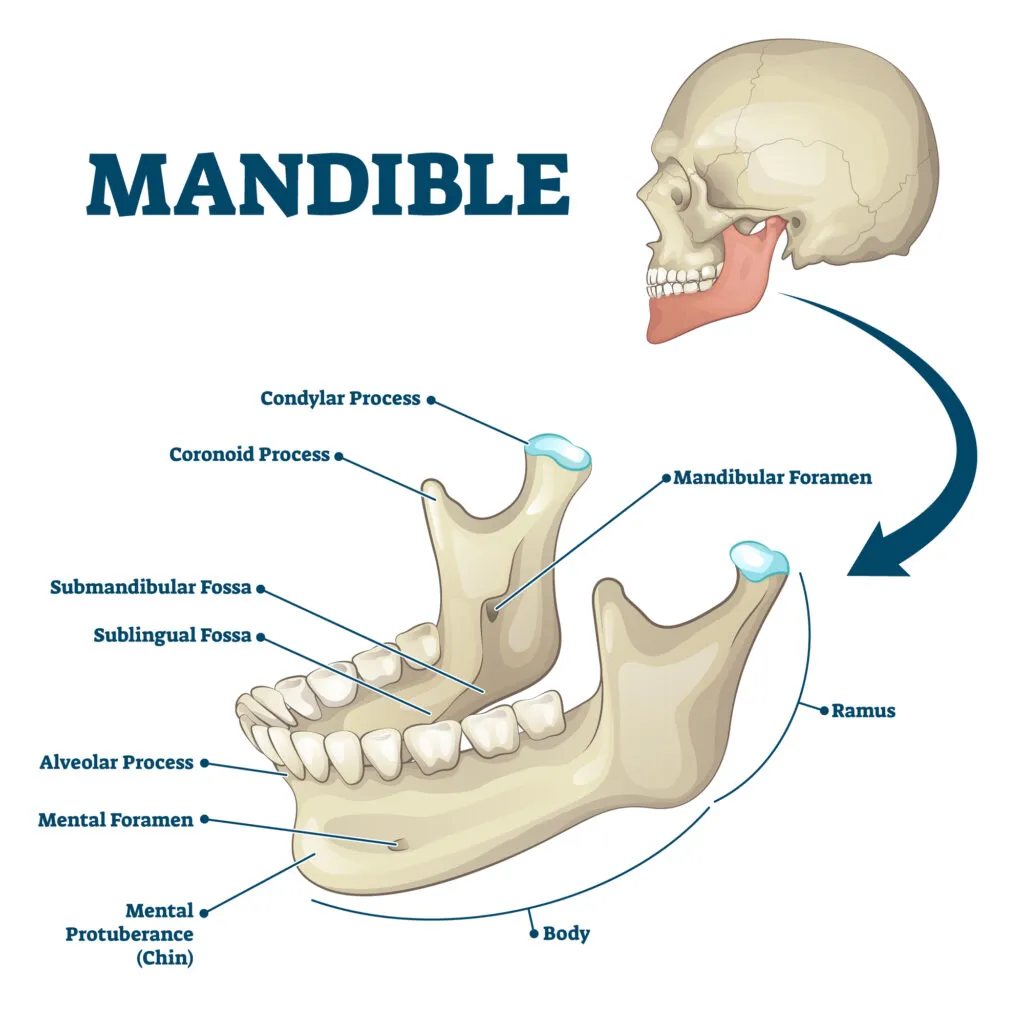
The mandible is located directly below the upper jaw and consists of the body and the ramus. The body is a symmetrical, horseshoe-shaped bone that forms the lower jawline.
There’s a ramus on each side of the body. The rami are vertical, wing-shaped structures that join the body at an angle.
Male mandibles are generally larger than female mandibles. They also have more pronounced muscle attachment points and are somewhat stronger.2
Below are the parts that make up the mandible:
Body
The body of the mandible is a huge, almost rectangular structure. It lies parallel or perpendicular to the floor, depending on whether the person is standing or lying flat. The chin gets its structure from this part of the bone.
In adults, the midline of the body’s external surface has a subtle ridge called the mandibular symphysis.
The body’s alveolar border (the upper surface of the mandible) is where the 16 lower teeth attach.
Ramus
The ramus is the vertical part of the jaw. It extends cranially from the angle of the mandible (gonial angle). It is the second-largest part of the mandible.
The gonial angle may range between 110 and 130 degrees depending on age, sex, and race.3
Each ramus consists of the following parts:
- Head — This part connects with the temporal bone to form the TMJ.
- Neck — This part supports the head and acts as the point of attachment of jaw muscles known as lateral pterygoid muscles, which attach to the pterygoid fovea.
- Coronoid process — This is the site of attachment for the temporalis muscle. The primary purpose of this muscle is to generate mandibular movements at the temporomandibular joint.8
Alveolar Process
The alveolar process is probably the most crucial part of the bone since it keeps the teeth in place via a joint process known as gomphosis.4
This part of the mandible extends from the mandibular body and comprises two bony plates.
Each side of the mandible has five primary teeth during childhood and seven to eight permanent teeth, depending on whether wisdom teeth or third molars are present.
Mandibular Foramen and Mental Foramen
The mandibular foramen is a bony canal found on the internal surface of the ramus. This mandibular canal acts as a passage for the inferior alveolar nerve, inferior alveolar artery, and veins which exit at the mental foramen.
The mental foramen is located at the external surface of the mandibular body between the first and second premolar. It’s where the mental nerve and blood vessels enter the mandibular canal. The mental nerve provides sensation to the lower lip.
Other Jaw Structures
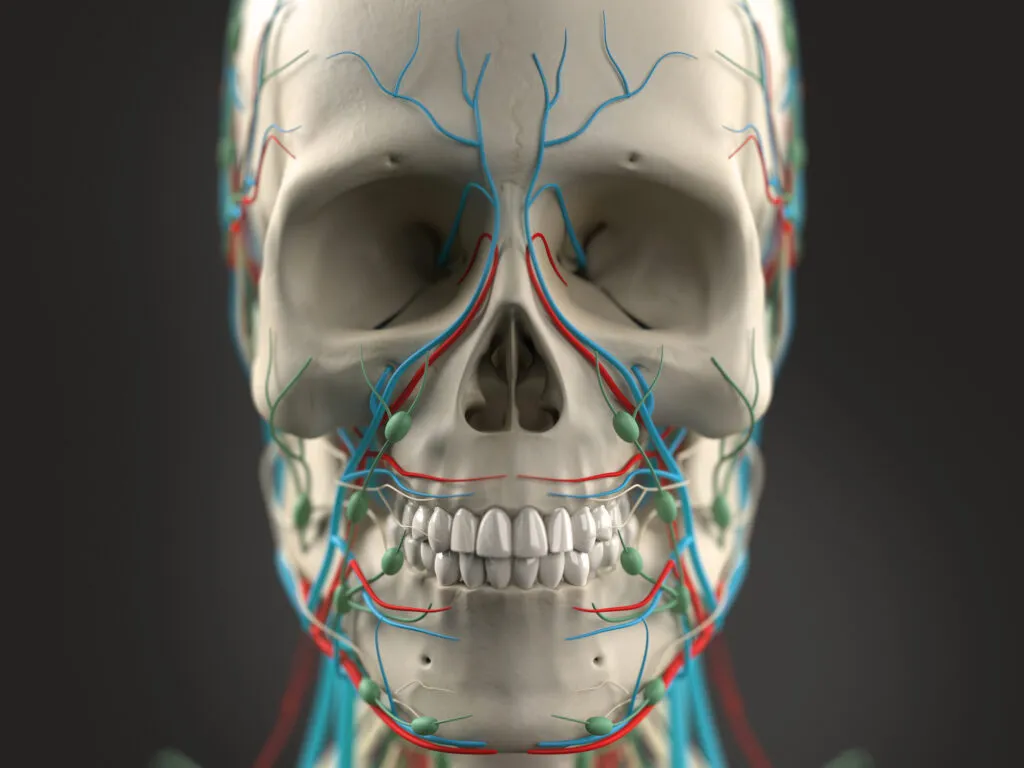
The mandible forms the skeletal structure of the lower jaw. Other parts of the jaw that are necessary for functioning include:
Blood and Lymph Vessels
The mandible gets its blood supply from small periosteal and endosteal vessels that branch off of multiple surrounding arteries. Mandibular teeth receive blood from dental branches of the inferior alveolar artery.
Lymphatic fluids from the mandible and mandibular teeth primarily drain through the submandibular lymph nodes.
Nerves
The main nerve that supplies the mandible is the inferior alveolar nerve. It branches from the mandibular division of the trigeminal nerve, which connects to the brain.
The inferior alveolar nerve enters through the mandibular foramen and travels upwards into the mandibular canal. There, the nerve branches to the lower teeth and provides sensation.
It branches again at the mental foramen, where it divides into the:
- Mental nerve — The mental nerve exits through the mental foramen to provide sensation to the lower lip.
- Incisive nerve — This nerve travels through the incisive canal and provides sensation to the mandibular central and lateral incisors, canines, and premolars.
Muscles
Many muscles attach to the mandible to help move your mouth in various ways. There are too many to list, but the primary muscles include:
- Buccinator — Originates from the alveolar process of the mandible and assists in chewing.
- Mylohyoid — The major muscle of the mouth’s floor.
- Superior pharyngeal constrictor — Connects to the mylohyoid and plays a key role in swallowing.
- Masseters — The superficial and deep masseter muscles insert into the rami. The masseter muscles are crucial to chewing.
- Medial pterygoid — A thick, rectangular muscle that helps with chewing.
- Lateral pterygoid — Allows the jaw to move downward and side-to-side.
- Temporalis — A fan-shaped muscle that runs along each side of the head and helps with chewing.
Summary
The human mandible, commonly known as the lower jaw, is the largest and strongest bone in the skull. It’s the only large skull bone that can move and is essential for speaking and chewing. Its mobility comes from its connection to the temporomandibular joint (TMJ).
The mandible is located below the maxilla (upper jaw). Its primary functions are to hold the lower set of teeth and assist with functions such as chewing.
The main parts of the mandible are the body and ramus. Other key structures include nerves, muscles, and blood and lymph vessels.
The Mandible Lower Jaw
NewMouth PodcastSources
- “The mandible and its features.”3D4Medical, 2020.
- Vinay, G, et al. “Sex Determination of Human Mandible Using Metrical Parameters.” Journal of Clinical & Diagnostic Research, 2013.
- Upadhyay, RB, et al. “Analysis of gonial angle in relation to age, gender, and dentition status by radiological and anthropometric methods.” Journal of Forensic Dental Sciences, 2012.
- “Alveolar Process.” International Congress of Oral Implatologists, 2019.
- “Misaligned teeth and jaws: Overview.” Institute for Quality and Efficiency in Health Care, 2020.
- “Temporomandibular Disorder (TMD).” John Hopkins Medicine, nd.
- “Sleep apnea.” Mayo Clinic, 2022.
- “Anatomy, Head and Neck, Mastication Muscles.” StatPearls, 2022.

UCLA-trained dentist practicing in public health. Focuses on whole-body approach to dental care.

Experienced dental health writer dedicated to providing accurate, accessible information.
Related Articles
White or Pale Gums - Causes, Remedies & When to See a Dr.
Why are my Gums White? Healthy gums are generally pink, like the surrounding tissues of the mouth (oral mucosa). Some co...

Why Does the Tip of My Tongue Hurt?
Why Does the Tip of My Tongue Hurt? You can experience pain on the tip of your tongue for many reasons. These range from...

Tight Jaw Causes, Tips for Relief, and Prevention
Why Does My Jaw Feel Tight? There are many potential causes of a tight jaw. Your lifestyle, jaw disorders, and certain i...
TMJ Surgery: Types, Costs, What to Expect, Procedure, and Recovery
Temporomandibular joint disorder (TMD) is a condition that affects the jaw joint. This article discusses the different t...