How Much Veneers Cost & Ways to Pay for Them


Reader-supported. We may earn a commission from links on this page. Advertising disclosure.
In this article
How Much Do Veneers Cost?
A traditional veneer costs between $1,000 and $1,230 per tooth. Porcelain veneers are the most expensive. Prepless, or no-prep, veneers like Lumineers are a little cheaper.
Depending on the type, the cost of veneers is as follows:
- Porcelain veneers — $500-$2,500 (per tooth)
- Composite resin veneers — $250-$1,500 (per tooth)
- Lumineers — $700-$2,000 (per tooth)
- Removable veneers — $300-$3,500 (per arch)
- Temporary veneers (trial veneers) — $200-$400 (per arch)
- Palatal veneers — $600-$1,200 (per tooth)
What’s Included in the Treatment Cost?
Veneer placement is typically separated into two appointments at a dental clinic. Here is what’s included in the treatment cost:
- Enamel removal to make room for the veneer
- An impression (or mold) of the prepared tooth structure
- A veneer shade that best matches your smile
- A custom-made veneer (this step can take several weeks—you may wear a temporary veneer in the meantime)
Does Dental Insurance Cover Veneers?
Dental insurance only covers necessary dental procedures. Because veneers are considered a cosmetic procedure, insurance doesn’t cover it.
However, if your veneers are recommended for your dental health, insurance might pay for a portion of the cost. For example, it might be considered a necessary procedure if your veneer covers jagged edges or corrects a malocclusion.
However, you can pay for veneers in other ways. Talk to your dentist about different payment plans and options.
Calculate your dental savings now with a DentalPlans plan: Visit DentalPlans.
What Are Dental Veneers?
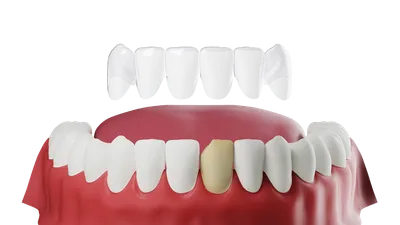
Dental veneers are coverings that fit over the surfaces of your front teeth (anterior teeth). Sometimes, only a portion of your tooth is covered by a veneer. However, at other times, an entire tooth can be covered.
Veneers use high-quality dental materials to conceal a wide range of dental problems, including:
- Chipped or broken teeth
- Gaps or spaces in your smile
- Stains or discolored teeth
- Teeth that are too small
- Misshapen teeth
Veneers can enhance the appearance of your teeth, giving you a smile makeover. However, veneers are limited and won’t be able to address serious oral health issues such as gum disease or cavities.
Evaluating the Cost Efficiency of Veneers
Veneers aren’t a perfect procedure, and they have certain advantages and disadvantages. You should discuss veneers and other options with your dentist to help decide whether it’s the best option for your budget.
Pros
- Longevity — Veneers can last many years when the dentist does their job properly. If you do your job caring for the dental work at home, veneers reduce the need for frequent replacements.
- Stain resistant — Veneers are more resistant to stains better than your natural tooth enamel. They maintain their appearance without succumbing to stains over time.
- Color stability — Porcelain is highly glazed glass. The color of veneers doesn’t change over time, contributing to their longevity.
- Increased confidence — Porcelain veneers make you look younger by covering and correcting chipped, shortened, and yellow teeth
Cons
- Cost — Veneers can cost hundreds of dollars per tooth and are usually not covered by insurance
- Time-consuming — They require a lengthy procedure to be placed and may require permanent removal of tooth enamel. While this contributes to their durability, it’s important to consider the time commitment during the treatment.
- Maintenance — Replacements may be needed after several years, and special attention to dental care is also needed to make veneers last a long time. Special attention to dental care is required to ensure their longevity, potentially incurring maintenance costs over time.
Calculate your dental savings now with a DentalPlans plan. Visit DentalPlans.
Tired of paying full price for dental work? Save with Discount Dental Plans. Learn more here or call [(833) 704-2246](tel:(833) 704-2246)
Financing Options for Veneers
A few options can help you save money on veneers:
Payment Plans
Some dentists offer payment plans that allow you to pay for veneers over time. These plans work by spreading out the cost of treatment.
You can choose from different financing options to lower the cost and interest of the procedure. However, the reduction can depend on the plan you choose.
You pay off some of the veneer(s) over a few months. This makes it easier to manage the treatment’s cost.
Discount Dental Plans
Fortunately, some discount dental plans may cover a portion of the cost.
Most dental discount plans work in similar ways:
- You only pay for the dental treatments you need (when you need them)
- No annual spending limit
- No claims or approval forms are required to sign up
- Members pay one low annual fee
- You will get access to a network of dentists in your area
Payment and discount dental savings plans are two ways to save money on veneers.
Types of Veneers
Several types of veneers are available:
Porcelain Laminate Veneers
Porcelain laminate veneers are the most natural-looking and durable veneer material available. They can last up to 20 years or longer, especially with proper dental care and good oral hygiene. Traditional porcelain veneers comprise several thin layers of ceramic material bonded together to form a strong shell.
Porcelain veneers are also extremely biocompatible, which means the mouth’s gums and other soft tissues respond well to them. These veneers can significantly improve the appearance of your smile because porcelain is very aesthetically pleasing.
Composite Veneers
Composite veneers are made of composite resin, a mixture of inorganic and organic materials. They’re also referred to as instant veneers, and they typically last between 5 and 7 years.
They blend in fairly well with your natural teeth. However, composite veneers are prone to stains over time and don’t last as long as porcelain ones.
Lumineers
Lumineers are a brand of veneers that can last up to 10 years. They’re made of ultra-thin porcelain laminate material and require minimal preparation before placement.
Unlike porcelain laminate veneers, less natural tooth structure is removed before placing a lumineer over your tooth enamel. As no-prep veneers, they also require minimal tooth preparation and are less invasive.
Removable Veneers
Removable veneers, or snap-on veneers, are cheaper and less durable than traditional veneers. They’re also considered trial or temporary veneers.
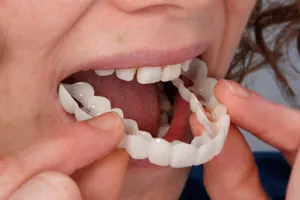
To create these veneers, an impression of your teeth is made. Then the impression is sent to a dental lab. The dental lab technicians create a custom-fit set of veneers, then mailed back to your dentist.
Palatal Veneers
Palatal veneers are also known as onlays. They’re used to restore posterior teeth, which are the surfaces behind the front teeth.
Composite palatal onlays offer a great solution to repair these areas of your teeth. Palatal veneers come in two different chemical compositions: porcelain and resin.
Get the dental care you need at a price you can afford. Find your DentalPlans savings now.
Alternative Treatments
Dental veneers can be expensive, especially if you want multiple veneers. Traditional veneers also require prepping, so our natural tooth structure will be removed before placement. This means veneers are permanent and cause irreversible changes. If you are unsure about veneers, a few reversible and less invasive dental treatments are available.
These include:
Teeth Whitening Treatment
Professional teeth whitening costs less than veneers, and the results are not permanent. Tooth-whitening treatments use peroxide-based bleaching agents to brighten your teeth,
At-home treatments contain 3% to 20% peroxide (carbamide or hydrogen peroxides). Meanwhile, in-office treatments contain from 15% to 43% peroxide.
In-office teeth whitening costs anywhere between $500 and $1,400 per treatment. At-home treatment can cost from about $30 to $300.
Dental Bonding
Dental bonding uses an adhesive and tooth-colored composite resin to whiten your teeth and/or fix tooth irregularities. Such fillings, or resin composites, are usually completed in one office visit, while veneers take two or more appointments.
They can cost anywhere between $300 and $600 per tooth. Indirect restorations, such as porcelain inlays, onlays, and crowns, can cost up to $1,500 per tooth.
Orthodontic Treatment
Orthodontic treatment may be better if you have many misaligned or crooked teeth and does not involve the removal of tooth enamel. Clear aligners and braces are popular choices.
Direct-to-consumer clear aligners cost less than braces and Invisalign. Typically clear aligners can cost between $6,000-$7,000. Meanwhile, the average braces cost is around $5,000 to $6,000.
Summary
Veneers are an effective way to improve the appearance of your teeth and smile. However, they can be costly and may not be covered by insurance.
Different types of veneers have different advantages and disadvantages. Veneers are also permanent for the most part and last between 15 to 20 years.
You must consider all the costs before committing to treatment. Talk to your dentist about payment plans and other financing options to help you afford veneers. If you’re unsure about getting veneers, ask your dentist about alternatives.
Sources
- “Dental Veneers: What Are Veneers, How Much Do They Cost, and Do I Need Them?” Guardian Direct.
- Goldstein et al. “Ronald E. Goldstein’s Esthetics in Dentistry.” Wiley Blackwell, 2018.
- Hollins, C. “Basic Guide to Dental Procedures.” John Wiley & Sons, Inc., 2015.
- Phinney, D.J., and Halstead, J.H. “Delmar’s Handbook of Essential Skills and Procedures for Chairside Dental Assisting.“ Delmar/Thomson Learning, 2002.
- Pini et al. “Advances in dental veneers: materials, applications, and techniques.” Clinical, cosmetic and investigational dentistry, 2012.
- Borges et al. “Study of Lumineers’ Interfaces by Means of Optical Coherence Tomography.” Biophotonics South America, 2015.
- Ivankova, M.V., and Krikheli, N.I. “Analysis of Results of Treatment of Patients with Discolored Teeth Using Different Types of Lumineers and Composite Veneers.” Medical Alphabet, 2020.
- “Alpha Veneers – Pricing.” Alpha Veneers.
- “What Are Temporary Veneers?” Shiny Smile Veneers.

UCLA-trained dentist practicing in public health. Focuses on whole-body approach to dental care.

Experienced dental health writer dedicated to providing accurate, accessible information.
Related Articles

Instasmile Snap On Veneers Review
Are Instasmile snap-on veneers right for you? Find out as we investigate customer reviews and compare its features with...
What Are Veneers?
Dental veneers can help fix many cosmetic dental problems. Learn the five types, how they work, costs, and side effects.
Trusmile Snap On Veneers Review (2026)
Can TruSmile's veneers help you achieve that Hollywood smile? Find out in our review and see how it compares with the be...
Shiny Smile Review (2026)
Find out what makes Shiny Smiles' veneers a great option. See how it compares with the best pop-on veneers.