How to Get Rid of Tonsil Stones Yourself: 6 Home Remedies


Reader-supported. We may earn a commission from links on this page. Advertising disclosure.
In this article
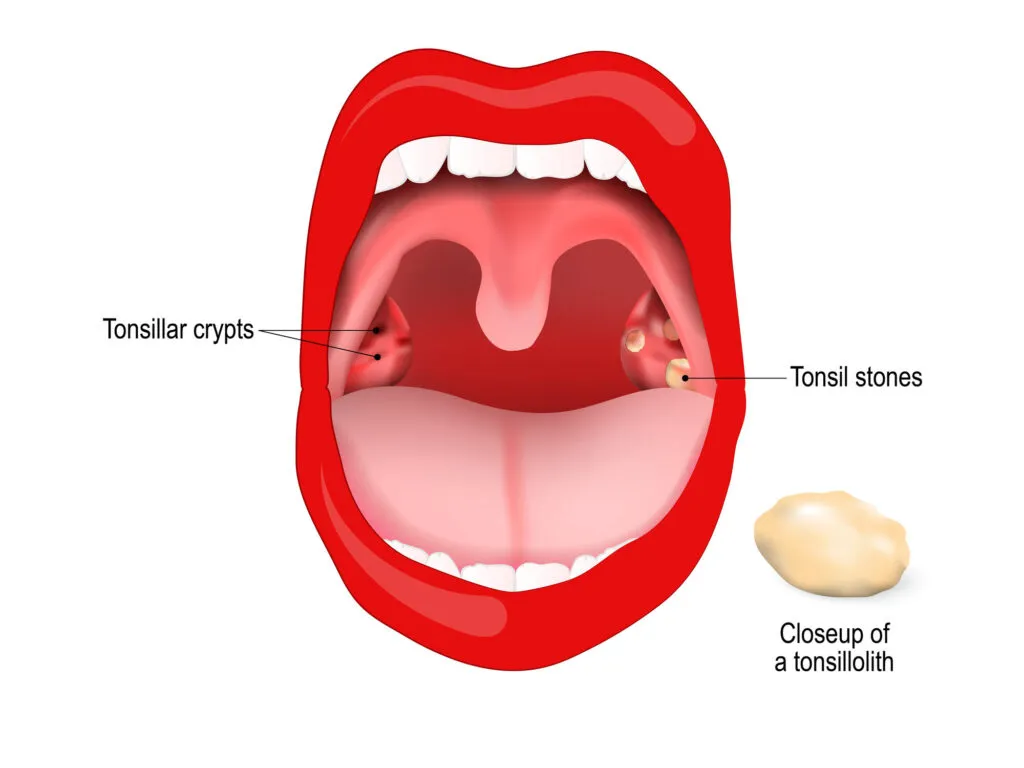
Tonsil stones (tonsilloliths or tonsilliths) are small calcified deposits that sometimes form on the surface of the tonsils. They’re often visible as white or yellow lumps in the back of your throat on your tonsils.
Tonsil stones form when food debris, mucus, or other particles collect in your tonsils. You can try removing tonsil stones on your own with a few home remedies.
6 Ways to Get Rid of Tonsil Stones at Home
Tonsil stones can be annoying, but fortunately, they often respond well to home remedies. Here are six methods you can try:
- Gargle — Gargling warm salt water can dislodge tonsil stones, relieve discomfort, and promote healing. You can also try apples, grape vinegar, or watered-down dates.
- Use an object — You can use blunt objects like cotton swabs, tongue depressors, or the back of a toothbrush to push the tonsil stone out.
- Use a water flosser — A water flosser or oral irrigator provides a safe, contact-free way to remove tonsil stones. Keep the water pressure low to avoid irritation or injury.
- Cough — Sometimes, a powerful cough can be enough to knock tonsil stones loose.
- Eat certain foods — Some people believe eating certain foods can help remove or prevent tonsil stones. These include yogurt, onions, water, and garlic.
- Wait — Tonsil stones sometimes go away on their own. Regular brushing, flossing, and gargling might be sufficient to eliminate them over time.
If you’re going to try and push tonsil stones out, be careful with sharp objects because you might injure yourself. You should also avoid using your fingers because you may introduce bacteria from your fingers.
What Causes Tonsil Stones?
The surfaces of your tonsils contain multiple small pockets or folds, known as tonsillar crypts. Over time, these crypts can accumulate material, which hardens or calcifies, resulting in pebble-like tonsil stones.
Aside from calcified solid material, tonsil stones often contain multiple living microorganisms, such as bacteria. The following may contribute to the formation of tonsil stones:
- Food debris
- Bacteria
- Fungi
- Mucus
- Dead cells
- Viral infections
Tonsil stones often occur on their own. They may also cause or be caused by chronic tonsillitis.
How to Prevent Tonsil Stones
You can prevent tonsil stones from forming by maintaining good oral hygiene. Regularly brush your teeth, floss, avoid smoking, and reduce your intake of sugary foods.
If you know you’re prone to developing tonsil stones, try the occasional salt water gargle after meals. This clears away food debris that may contribute to tonsil stone formation.
Symptoms of Tonsil Stones
When you get tonsil stones, you may start to feel something stuck in your throat. You’ll experience bad breath, coughing, sore throat, and have some problems swallowing.
If your tonsil stones are part of a tonsillitis infection, you might also notice the following symptoms:
- Swollen tonsils
- Tonsil or throat redness
- Swollen lymph nodes
- Fever
Are Tonsil Stones Serious?
While tonsil stones aren’t usually considered a serious health risk, they sometimes feel uncomfortable. Additionally, recurrent infections cause inflammation, which can enlarge the tonsillar crypts.
If you experience chronic tonsillitis or recurring tonsil stones, visit your doctor. Tonsil stones can also lead to a peritonsillar abscess, rheumatic fever, or kidney inflammation. However, these are typically rare in the developed world.
When to See a Dentist for Tonsil Stones
Talk to your doctor or dentist about tonsil stones that:
- Recur
- Cause constant pain or discomfort
- Make talking, breathing, or sleeping difficult
- Occur together with a tonsil or throat infection
These cases may require professional care, whether to get rid of the tonsil stones or to treat an underlying infection.
According to Dr. Nandita Lilly, “Immunocompromised patients who develop chronic tonsil stones should see their dentist and possibly an ENT for evaluation and treatment.”
Medical Treatments For Tonsil Stones
If you’re having a hard time removing tonsil stones at home, a doctor or dentist can help. On the other hand, tonsil stones that are large or problematic may need to be removed surgically through a procedure called tonsillectomy.
Tonsillectomy is a procedure that completely removes tonsils. It can also improve the quality of life in people with severe, recurring throat or tonsil infections.
However, tonsillectomy provides little or no benefit in other cases. It can also lead to complications, including postoperative bleeding. the surface of the tonsils. They’re often visible as white or yellow lumps in the back of your throat on your tonsils.
Sources
- Yellamma et al. “Tonsillolith: A polymicrobial biofilm.” Medical Journal, Armed Forces India, National Library of Medicine, 2015.
- Huynh et al. “Rinsing with Saline Promotes Human Gingival Fibroblast Wound Healing In Vitro.” PLOS ONE, 2017.
- Al-Saadi et al. “Detection of biofilm formation and effect of vinegar on biofilm of Streptococcus pyogenes isolated from patients with tonsillitis.” International Journal of PharmTech Research, ResearchGate, 2016.
- Abu Bakar et al. “Chronic tonsillitis and biofilms: a brief overview of treatment modalities.” Journal of Inflammation Research, National Library of Medicine, 2018.
- Bohr C, & Shermetaro C. “Tonsillectomy and Adenoidectomy.” Treasure Island (FL): StatPearls Publishing, 2024.
- Mitchell et al. “Clinical Practice Guideline: Tonsillectomy in Children (Update).” Otolaryngology – Head and Neck Surgery, Sage Journals, 2019.
- Chen et al. “Comparison of Post-Tonsillectomy Hemorrhage between Monopolar and Plasma Blade Techniques.” Journal of Clinical Medicine, MDPI, 2021.
- Georgalas et al. “Tonsillitis.” BMJ Clinical Evidence, National Library of Medicine, 2014.
- Sharma et al. “Systematic study on active compounds as antibacterial and antibiofilm agent in aging onions.” Journal of Food and Drug Analysis, 2018.

Board-certified general dentist specializing in patient education and preventive dentistry.

Experienced dental health writer dedicated to providing accurate, accessible information.
Related Articles

Do Cavity Fillings Hurt?
Do cavity fillings hurt? In this post, you'll learn how to tell if you have a cavity, what the pain level is during the...

Laser Teeth Whitening: Pros, Cons, & Costs
Laser teeth whitening uses light energy to break down stains on tooth enamel. Learn more about the cost and how it works...
Tooth Sensitive to Cold: Causes, Remedies, and Prevention
Is your tooth sensitive to the cold? Here's what you need to know about the causes, remedies, and prevention of teeth se...
How to Get Low-Cost Dental Implants
Dental implants can be one of your best options if you're suffering from damaged or missing teeth. Read on to find out h...