Braces Statistics and Facts

Reader-supported. We may earn a commission from links on this page. Advertising disclosure.
In this article
Twisted, squeezed together, or stubbornly hiding, your teeth can surprise you in many ways.
No wonder orthodontics braces have soared in popularity worldwide. Everybody wants a perfect set of pearly whites, and they are the best way to achieve that.
But just how many people get braces? Here are some braces statistics that may surprise you.
Braces Statistics and Facts
- Orthodontics is a branch of dentistry that corrects malocclusions or misalignments of the teeth.
- Orthodontists use brackets and wires to apply gentle yet effective physiologic forces to reposition teeth gradually.
- About 25% to 53% of people will require orthodontic intervention.
- Fixed braces—the metal kind—remain the popular choice for many (4.5+ million) despite the emergence of clear aligners (1.5+ million).
- On average, people can complete comprehensive orthodontic treatment in under two years.
- Crooked teeth have a deep-rooted history, dating as far back as 40,000 to 130,000 years ago.
- Egyptian mummies wore primitive metal bands on their teeth, giving a glimpse into early orthodontic practices.
- Simple fixes may only take six to ten months to complete. In contrast, a total dental revamp with bite correction could take a few years.
- Children are ready for their first orthodontic check-up by 7 years old.
- The average cost of traditional braces is around $5,900, while Invisalign comes with a slightly higher price tag of $6,500.8 At-home clear aligners are the cheapest way to straighten teeth.
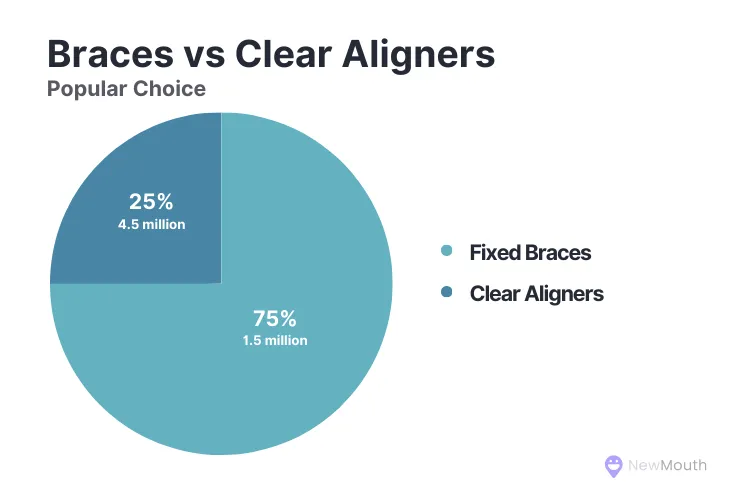
How Many People Get Braces in Their Lives?
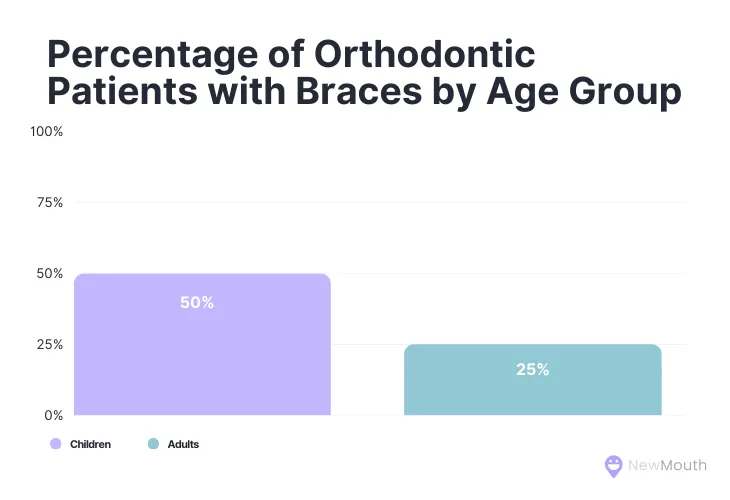
Four million Americans, mainly teens (80%), wear braces. Meanwhile, nearly 25 to 50% of all children will also be braces-wearers.
Interestingly, a third of the global population has worn braces. A whopping 1.6 million adults are also sporting it, making up an impressive 20 to 25% of all orthodontist patients.
At the heart of this movement from grown-ups is their desire to enhance their smile. Their understanding that orthodontics improves health and wellness further boosts this demand.
Retainers Statistics and Facts
- Retainers help bones around your teeth solidify while preserving their new alignment after braces come off.
- Retainers have two types: removable and fixed.
- Removable retainers have two kinds: wire retainers with wire and plastic-like materials to secure teeth and clear retainers with a transparent, teeth-hugging design.
- Fixed retainers are fashioned from a sleek, tailor-made wire that bonds to the hidden side of teeth.
- Wearing retainers every night for a lifetime maintains a perfect smile.
- The orthodontic retainers market could grow to $487.05 million by 2028, with a compound annual growth rate (CAGR) of 10.32%.10
- Clear plastic and molded acrylic retainers range from $200 to $600, while bonded retainers can set you back anywhere from $500 to $1,000.11
Braces Statistics and Facts
NewMouth PodcastSources
- “What percent of the population gets braces?” Calendar Canada, n.d.
- Gopalakrishnan, U., et. al. “Sulfate-Reducing Bacteria in Patients Undergoing Fixed Orthodontic Treatment.” International Dental Journal, 2023.
- Geoghegan F, et al. “Motivation, expectations and understanding of patients and their parents seeking orthodontic treatment in specialist practice.” Journal of Orthodontics, 2019.
- Baum, A. “7 Facts About Orthodontics.” American Association of Orthodontists, 2018.
- “How Orthodontics Works: Braces.” American Association of Orthodontists, 2020.
- “When Should Your Child See an Orthodontist?” American Association of Orthodontists, 2020.
- LaPonsie, M. “The Average Cost of Braces and How to Save.” U.S News, 2022.
- “Will I Need to Wear Retainers After Treatment?” American Association of Orthodontists, 2019.
- “Global Orthodontic Retainers Market – Industry Trends and forecast to 2028.” Data Bridge Market Research, 2021.
- “Average Costs: Dentistry and Orthodontia.” Care Credit, n.d.

Lead content writer and certified nutritionist focusing on clear aligners and teeth whitening.
Related Articles

Hyperdontia: Extra Teeth in Children and Adults
Learn all about hyperdontia - a condition characterized by an excessive number of teeth. Find out the symptoms, causes,...

Sensitive Teeth
Do you have sensitive teeth? We discuss this common condition's causes and treatment options. You'll also learn at-home...
Loose Crown
Dental crowns can become loose for various reasons. Learn important facts about what can cause a loose crown, its signs,...

Why Is My Tongue Itchy?
Find out why your tongue might be feeling itchy and what you can do about it. You will find the causes and home remedies...