Snap-On Smiles: How They Work & Costs


Reader-supported. We may earn a commission from links on this page. Advertising disclosure.
In this article
What is a Snap-On Smile®?
A Snap-On Smile is a brand of removable snap-on veneers (also called “temporary” or “clip-on” veneers). It clips over your natural teeth to give you a “Hollywood smile” without drilling or permanent veneers.
Wearing snap-on veneers can give you an affordable smile makeover. Many people feel more confident because they look similar to natural teeth.
These snap-on veneers are thin, durable, and made of hi-tech dental resin. Snap-On Smile is a comfortable alternative to help people avoid the discomfort of complex cosmetic dental treatments.
How Does Snap-On Smile Work?
The Snap-On Smile process takes place at a dental office. It takes two visits and consists of three steps:
- The dentist takes an impression of your teeth and sends it to a lab.
- The lab technicians make a custom-fitted set of Snap-On Smile removable veneers and mail them back to your dentist.
- The dentist makes sure the Snap-On Smile fits properly
Depending on the patient, a Snap-On Smile can be a temporary or long-term cosmetic solution. The product is available for both the upper and lower teeth.
Snap-On Smiles don’t require drilling, shots, or adjustments in tooth structure. Cleaning your device is also simple when using the brand’s proprietary cleaning solution.
Pros and Cons of Snap-On Smile
Snap-On Smile is painless, removable, and costs less than traditional veneers, but it can feel uncomfortable and may trap bacteria if not cleaned regularly:
Pros
- Cost-effective – Traditional veneers are quite expensive, but snap-on veneers can be a more cost-effective solution. They also require fewer dental visits, saving you time.
- Painless – Snap-on veneers don’t require the removal of tooth structure before placement.
- Removable – Since snap-on veneers are removable, they’re easier to clean. The easy cleaning process also aids in maintaining good oral hygiene.
- Quick aesthetic improvement – Snap-on veneers can improve your smile’s appearance quickly. You can use them for special occasions or while waiting for other dental treatments.
Cons
- Uncomfortable – Wearing snap-on veneers can be uncomfortable, and it can take time to adapt compared to traditional veneers.
- Oral health issues – Not cleaning your snap-on veneers regularly can increase the risk of cavities and other oral health issues.
- Durability – While snap-on veneers are durable, they should never replace necessary dental work and orthodontic treatment (like braces).
- Eating and drinking limitations – You should avoid certain food and drink so you don’t stain or chip your snap-on veneers.
Cost of Snap-On Smile
Generally, a Snap-On Smile costs between $1,000 and $3,500 or more per upper or lower arch. Some dentists may charge as low as $500 to $1,000 per arch.
The cost of snap-on veneers varies depending on the size, shape, and style of the teeth. Prices can differ significantly between dentists, even in the same area.
Who Benefits From Snap-On Smiles?
A Snap-On Smile is an affordable solution that can address the following:
- Stained teeth
- Slightly crooked teeth
- Chipped teeth
- Missing teeth or gaps (fully healed)
- People who want a more comfortable, modern alternative to cosmetic removable partial dentures
Who Shouldn’t Get Snap-On Smiles?
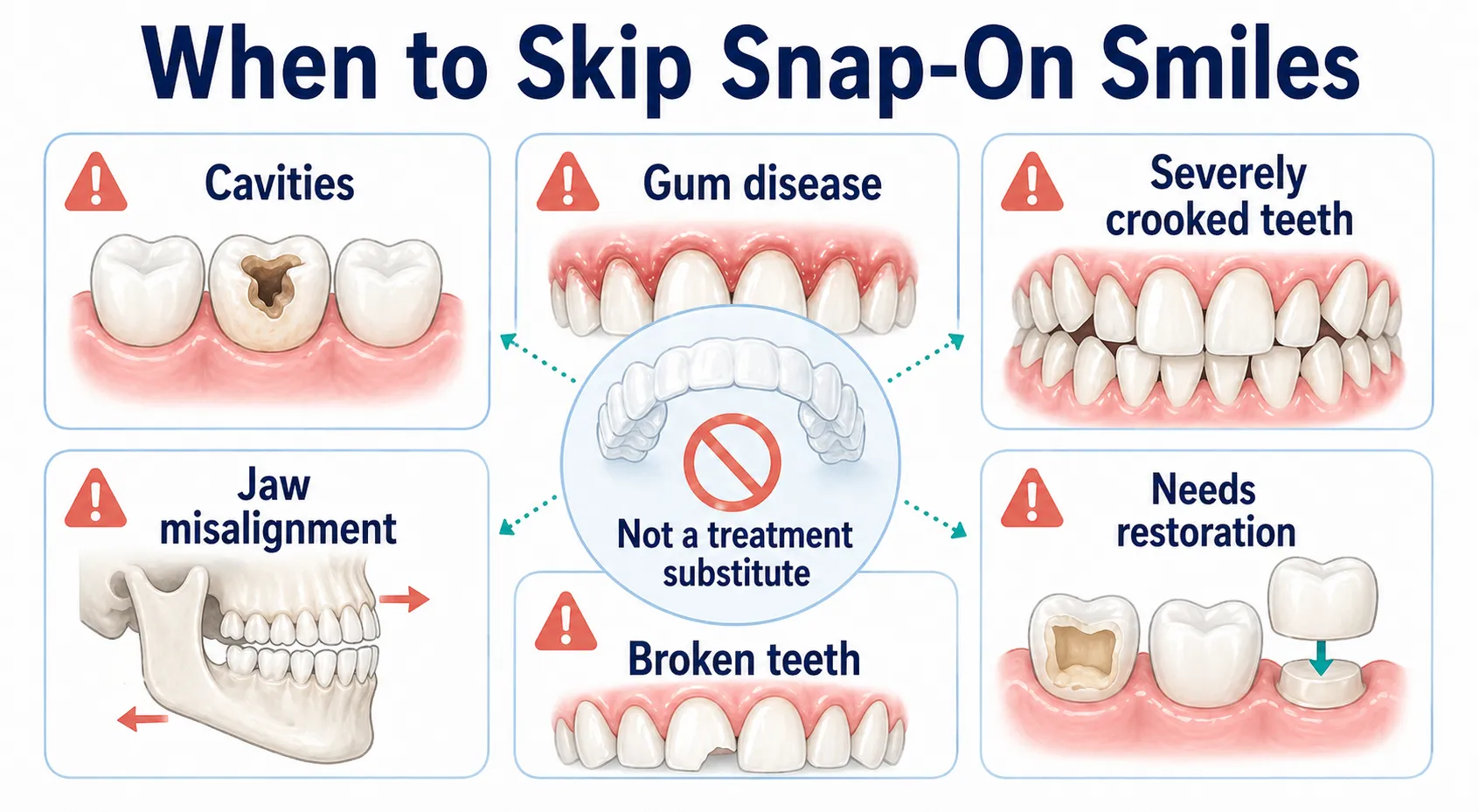
People who need dentures or other dental restorations for medical reasons should not replace them with a cosmetic Snap-On Smile.
You shouldn’t get Snap-On Smile if you need restorative or orthodontic treatment for conditions like:
- Cavities
- Gum disease
- Severely crooked teeth
- Jaw misalignment issues
- Damaged, chipped, or broken teeth
- Other oral conditions
Do Snap-On Smiles Really Work?
A Snap-On Smile is an affordable and convenient way to cover up dental problems, close small gaps, and improve aesthetics. However, these devices should never replace necessary dental work and orthodontics like braces.
Risk Factors of Snap-On Smiles
If you choose Snap-On Smile treatment, remember that it can negatively affect oral health and natural teeth. Some of the risk factors include:
Increased Risk of Plaque
Because of the gap between snap-on teeth and natural teeth, dental plaque can spread easily from tooth to tooth.
Increased Risk of Decay
When you wear a Snap-On Smile, saliva does not wash away bacteria as quickly as it usually would. That raises the risk of tooth decay from bacteria trapped between your natural teeth and the appliance.
Discomfort
Snap-On Smiles can feel uncomfortable when they are first fitted. Inserting and removing them can also be difficult.
Softening of the Snap-On Smile Teeth
You cannot consume hot liquids while wearing snap-on teeth because heat can soften the device. That can make them unusable at inconvenient times.
Poor Quality
Snap-On Smiles wear down over time. They are less strong, durable, and protective than professional dental restorations. If durability matters, professional options such as dentures are a better choice.
Alternative Removable Veneer Companies
Several at-home snap-on veneer companies ship impression kits directly to you, often at a lower price than Snap-On Smile:
- Removable Veneers USA
- Alpha Veneers
- TruSmile
- instasmile
- Shiny Smile Veneers
The treatment process is similar to Snap-On Smile, but these companies ship an impression kit to your home. Your impressions still go to a professional dental lab, then the finished veneers are sent back to you.
Alternative Dental Treatments
A Snap-On Smile is not for everyone, and several alternatives can also improve your smile. These include:
Veneers
Veneers are a cosmetic dentistry procedure that improves the appearance of teeth. They are thin, customized shells that cover the front of your teeth to change their color, shape, and/or size.
Dental veneers are made of either ceramic porcelain or composite resin. Porcelain veneers look more natural on existing teeth than composite veneers and Snap-On Smile.
Dental Bonding
During a dental bonding procedure, a tooth-colored resin material is applied and hardened with a special curing light.
This procedure bonds the resin material to the tooth to restore or improve its appearance.
Clear Aligners
Clear aligners such as Invisalign, Smile Direct Club, and Candid Co straighten teeth gradually using a series of clear, thin, comfortable trays.
Braces
If you have issues with your bite or the spacing of your teeth, you may need braces. Traditional metal braces correct bite problems, close gaps between teeth, and align your jaw and teeth.
Metal braces move teeth with brackets attached to specific points on the teeth. Traditional braces can take up to two years to straighten teeth.
Teeth Whitening
A Snap-On Smile is a part-time or temporary solution for people with stained or discolored teeth. Many teeth whitening treatment options can help you brighten your smile.
Dental Implants
Dental implants replace missing teeth or are used for people who need teeth removed. They are made of alloplastic materials implanted into the oral tissues beneath the mucosa, periosteum, or jaw bone.
Dental implants offer retention and support for a fixed or removable dental prosthesis.
Summary
Snap-On Smile is a great way to improve your smile without the commitment of braces or other treatments. It offers a fast and simple solution for short-term cosmetic improvement.
However, you should visit a licensed dentist for professional advice before investing in any type of cosmetic dentistry procedure.
Sources
- Snap On Smile, 2018
- Veneers, Health Direct, 2018, https://www.healthdirect.gov.au/veneers
- Tamer, İpek et al., Orthodontic Treatment with Clear Aligners and The Scientific Reality Behind Their Marketing: A Literature Review., Turkish journal of orthodontics, 2019
- Gupta R, Gupta N, Weber KK. Dental Implants, StatPearls. Treasure Island (FL): StatPearls Publishing; 2020 Jan
- Esquivel, Jonathan et al. “The utilization of snap-on provisionals for dental veneers: From an analog to a digital approach.” Journal of esthetic and restorative dentistry : official publication of the American Academy of Esthetic Dentistry, 2020
- Alani, A et al. “Balancing the risks and benefits associated with cosmetic dentistry - a joint statement by UK specialist dental societies.” British dental journal, 2015

Licensed dental specialist focusing on personalized dental content writing and blogging.

Freelance writer focused on authoritative dental content and oral hygiene guidance.
Related Articles
Veneers Before and After
Veneers are a popular cosmetic dental procedure that can dramatically improve the appearance of your smile. Different ki...
Composite Veneers: Costs, Procedure, Pros, and Cons
Key Takeaways Composite veneers are shell-like dental restorations that fit over your teeth. They're ideal solutions for...

7 Best Snap-On Veneers (2026)
Snap-on veneers are an affordable and convenient way to achieve a perfect smile. We give you seven of the best snap-on v...
Does Baking Soda Whiten Teeth?
Does baking soda whiten teeth? Get the facts on baking soda and hydrogen peroxide for whiter teeth, plus the risks and b...