Candid vs. Invisalign Review (2026)


Reader-supported. We may earn a commission from links on this page. Advertising disclosure.
In this article
Candid and Invisalign have many similarities. Both clear aligners treat mild to complex tooth alignment issues and require you to see a partner dental professional to begin treatment.
However, Invisalign is an in-office aligner that involves regular visits with your provider. Candid offers the convenience of at-home monitoring.
To help you pick the best clear aligner between the two, we asked our team to compare their pros, cons, and any features that make them stand out.
Candid vs. Invisalign Highlights
Here are the main differences between the two clear aligners:
| Candid | Invisalign | |
|---|---|---|
| Treated Cases | Mild to complex | Mild to complex |
| Average Treatment Time | 6 to 12 months | 6 to 18 months |
| How To Start Treatment | In-person | In-person |
| Progress Monitoring | Remote | In-person |
| Treatment Cost | $3,300 to $5,000 | $3,000 to $8,000 |
| Financing | Depends on your provider | Depends on your provider |
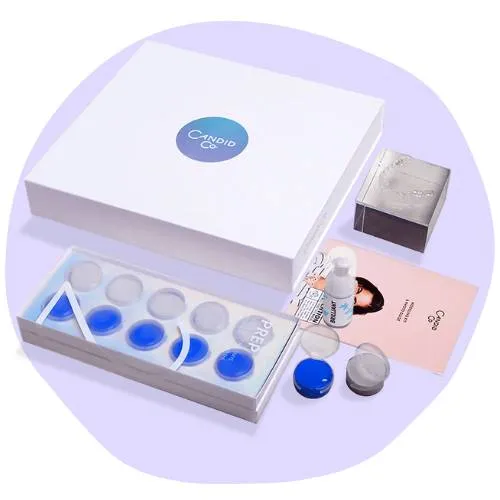
We recommend Candid if you want a comprehensive but convenient way to straighten your teeth. Like Invisalign, it can treat complex cases and some bite issues. But you only need one in-person visit. The rest of your treatment can be completed at home, where a licensed dentist or orthodontist can monitor your progress through an app.
When to Choose Invisalign Aligners
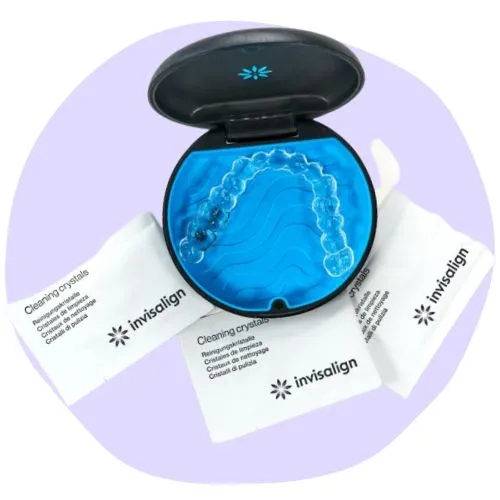
Invisalign is the best choice if you prefer being seen by a licensed dental professional. While it costs more than Candid, a dentist or orthodontist will oversee your treatment at a clinic and adjust them as needed. This level of in-office care ensures safe and effective teeth straightening.
Book an Invisalign Consultation Read our Invisalign review
Which Is Better—Candid or Invisalign?
Both Candid and Invisalign can effectively straighten teeth. Understanding their unique features can help you choose the best one for your needs:
Invisalign: Best Treated Cases
Candid and Invisalign move all of your teeth, even your molars. This enables both brands to treat orthodontic issues that at-home aligners can’t, like complex teeth misalignments and certain bite problems.
However, Invisalign can treat more cases by providing up to 50 aligner trays with your treatment plan. Candid can only give you up to 24 trays.
Invisalign also offers more treatment plans and attachments for precise movements. While Candid works for adults and teenagers aged 13 to 17, Invisalign can treat adults, teens, and kids as young as 6.
Candid: Best for Convenient Treatments
Candid has a more convenient approach to clear aligner treatment, requiring only an initial in-person visit for impressions and digital scans.
When your aligners are ready, the entire set will be shipped to your home. A licensed dental professional will then monitor your progress remotely through the ProMonitoring app, and you’ll send photos every two weeks.
Patients with mild cases make excellent candidates for at-home aligner treatment. Patients who have demanding work schedules, or are worried about making the time for office visits, appreciate the independence that comes with this option. Additionally, patients who are very committed to their treatment timeline and will be able to keep themselves on track see the most success with these treatment plans.
Dr. Elvi Barcoma, Smile Doctors Orthodontist
Invisalign requires you to check in with your provider every 4 to 6 weeks so they can monitor your progress and change your aligners. This makes it a less convenient option if you’re busy or would rather stay home.
Invisalign: Best Professional Care
Invisalign is the better choice if you prefer seeing a dental professional and are willing to visit their clinic throughout the treatment.
It helps ensure safer and more effective teeth straightening than Candid since they can directly oversee your progress.
Patients following at-home aligner treatment need to be proactive about wearing their aligners for the recommended 20-22 hours per day. For patients who may not be as disciplined with their aligner wear, having the accountability of in-office visits may be needed.
Dr. Elvi Barcoma, Smile Doctors Orthodontist
During these visits, your Invisalign provider will determine if you can switch to the next aligner or need to wear your current tray for a few more weeks. They’ll also make sure your new aligner fits perfectly.
If you have stubborn teeth, your dentist or orthodontist may suggest Invisalign attachments or dental procedures promoting teeth movement without compromising your safety.
Candid: Best for Faster Treatments
Candid and Invisalign have longer treatments than at-home clear aligners, but only because they straighten your full arch and not just your front teeth.
But if you prefer faster treatments, Candid aligners usually need 8.5 months to straighten your smile. Invisalign can take up to 24 months to correct complex teeth alignment issues.
Invisalign: Most Accessible Aligners
Candid no longer offers impression kits online. So, if you want clear aligners that are easier to access, we recommend Invisalign.
There are more than 40,000 Invisalign providers. While Candid is available in all 50 U.S. states, the exact number of dental partners isn’t known. You’ll have to check for a CandidPro provider in your location.
Candid: Best Value for Money
When it comes to treatment costs and payment options, Candid and Invisalign aren’t too far apart. Both clear aligners can cost upwards of $3,000, so they’re quite pricey. You can pay them using your Health Savings Account (HSA), Flexible Spending Account (FSA), or financing.
However, Candid offers better value for your money overall. That’s because you’ll get the following with your clear aligners:
- A free set of retainers — keeps your teeth straight
- Whitening foam — cleans aligners and whitens teeth
- Chewies — helps you fit the aligners
- Scanbox Pro — for taking scans of your teeth
Invisalign doesn’t offer these perks with your treatment costs. You would have to spend on additional teeth whitening and retainers.
Both brands leave the cost of the retainers to their providers, so maintaining your teeth after the treatment can be expensive.
Candid vs. Invisalign: Which is Right for You?
Candid and Invisalign share many similarities, which can make it harder to choose. When deciding between them, you should consider the following:
- Your budget for the treatment
- The severity of your condition
- The treatment process
- How soon you want to see results
- Cost of post-treatment retainers
Both brands work with licensed dental professionals across the U.S. and require you to see one for an initial assessment. But if you value convenience and faster treatments, you should go with Candid.
Candid works for minor to complex alignment issues. Unlike Invisalign, the brand ships all of your aligners so you can finish your treatment at home. They’ll monitor your progress at home through an app.
But if you have a more severe case and prefer seeing a dental professional as you switch from one aligner to the next, you should pick Invisalign.
Patients with more complex cases, untreated underlying conditions, or an active periodontal disease with lack of bone or unhealthy gum tissue should consider traditional, in-clinic treatment to ensure these conditions are monitored closely. Prior to moving teeth, an examination and radiograph are important to ensure the best treatment approach is taken to achieve a healthy and confident smile.
Dr. Ryan Hurley, Smile Doctors Orthodontist
While Candid is also a safe and effective option, Invisalign’s in-office visits ensure more predictable results. The brand also offers attachments for more precise teeth straightening.
Ultimately, it’s best that you talk to a dental professional. They can help you determine which orthodontic treatment is best for you. If clear aligners aren’t adequate, they might suggest alternatives like braces.
Sources
- “Straighten Your Teeth in an Average of 6 Months.” Candid.
- “Candid Clear Aligners.” Candid.
- “Candid Starter Kit.” Candid.
- “Our Most Frequently Asked Questions.” Candid.
- “Discover the Candid Difference.” Candid.
- Proffit et al. “Contemporary Orthodontics.” Elsevier/Mosby, 2019.
- Wexler, A. et al. “Direct-to-Consumer Orthodontics: Surveying the User Experience.” The Journal of the American Dental Association, 2020.

Licensed dental specialist focusing on personalized dental content writing and blogging.

Lead content writer and certified nutritionist focusing on clear aligners and teeth whitening.
Related Articles

Candid Aligners Reviews (2026)
In this comprehensive Candid aligners review, you'll learn about their pros and cons, what to expect during your alignme...
Can Invisalign Fix an Excessive Overbite?
Can clear aligners correct an overbite? Read on to find out. You'll also learn how clear aligners work and how to know i...
Invisalign Review (2026)
Learn more about Invisalign, the pros and cons of this type of orthodontic treatment, and how it can help you get the be...

Clear Aligner Treatment
If you're considering clear aligners, read this guide to learn if you qualify for the treatment. You'll also learn how t...