Overbites: Causes, Complications & How To Fix Them


Reader-supported. We may earn a commission from links on this page. Advertising disclosure.
In this article
Finding out your child has an overbite isn’t something to be worried about. Overbites are common and often correctable.
Let’s explore what an overbite is, why it happens, and what solutions are available. Understanding this can help you make informed decisions for treatment.
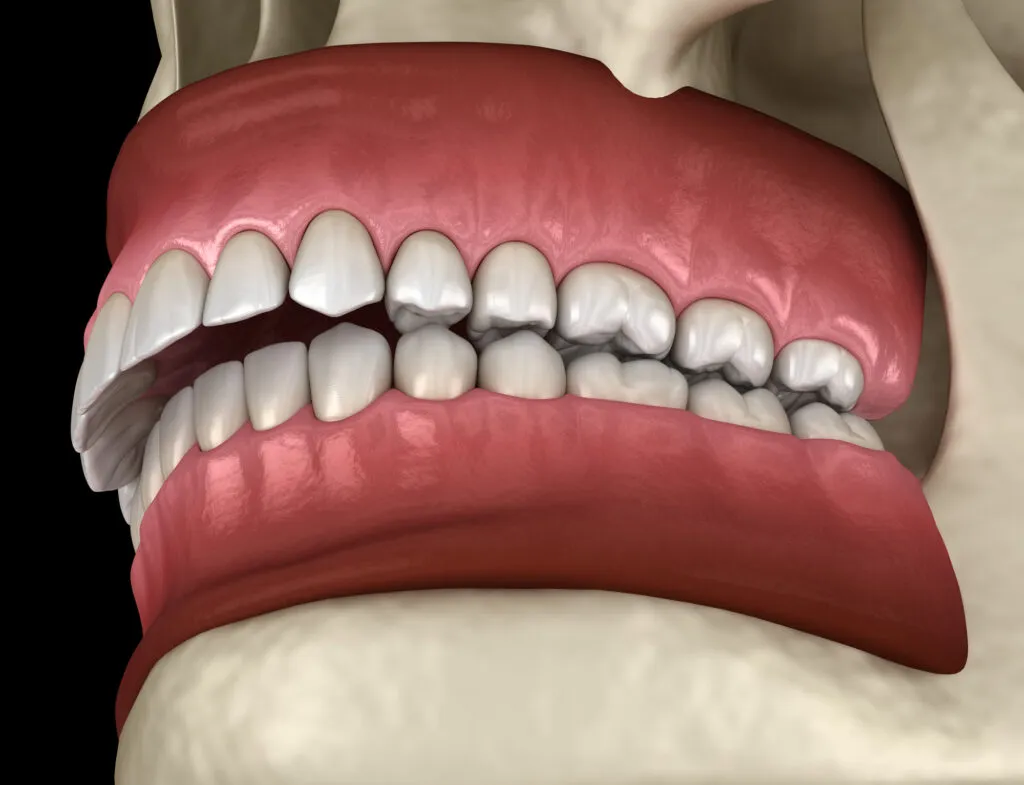
What Is an Overbite?
It’s normal for your upper teeth to overlap the lower ones by 2 to 3 millimeters. However, an overlap of more than 4mm, or an overbite, can pose functional and aesthetic problems.
An overbite (buck teeth) is a malocclusion of the teeth. Its most common cause is genetics, and it typically develops in childhood.
Additionally, childhood habits like extended pacifier use, bottle use, thumb-sucking, and nail biting can contribute to dental misalignments, including potential overbites.
In some cases, the jawbones don’t align properly. Severe jaw misalignment might need surgery, while teeth alignment issues usually respond well to orthodontic treatments.
What Are the Different Types of Overbites?
There are 2 types of overbites: a skeletal overbite and a dental overbite. Skeletal overbites are caused by irregular jawbone development, causing the jaw and teeth to grow improperly.
This can cause your mouth to be too big or too small for teeth to fit correctly. Meanwhile, a dental overbite is caused by habits that disrupt the development of teeth.
Straighten your teeth at a fraction of the cost. Learn about clear aligners.
What Are the Signs of An Overbite?
The best way to find out if you or your child has an overbite is to look in the mirror while biting down. If most of your lower teeth are hidden by your top teeth, then you may have an overbite.
Other common symptoms of an overbite include:
- Difficulty opening or closing your mouth
- Jaw pain or lockjaw
- Discomfort while eating
- Speech issues
- Earaches and headaches
If you have these symptoms, see your dentist. They will be able to provide the most accurate diagnosis and treatment.
What Are the Different Severities of An Overbite?
Dentists and orthodontists categorize overbites by how much the top teeth overlap the bottom:
| Category | Overlap | Description |
|---|---|---|
| Normal (Class I) | 1 to 3 mm (20 to 40%) | Minimal overlap, typically no treatment needed unless cosmetic concerns arise. |
| Deep/Moderate (Class II) | 4 to 8 mm | Higher risk of tooth wear, jaw discomfort, and gum problems. Often requires braces. |
| Severe/Impinging (Class III) | 9 mm or more | Lower teeth may press into the gums or the palate, causing TMJ disorders, speech issues, or tooth loss. |
Find the best at-home clear aligners for mild misalignment. See our expert recommendations.
Common Misconceptions About Overbites
There are a few misconceptions about overbites that may cause people not to get them corrected. These include:
- Overbites are only cosmetic issues — A severe overbite can lead to gum disease, jaw pain, and even sleep apnea. Even mild cases can lead to uneven tooth wear.
- No overbite is ideal — A completely edge-to-edge bite places too much force on the teeth. A slight overbite helps distribute chewing forces and protects your front teeth.
- Overbites are the same as an overjet — While they similarly overlap, an overjet occurs when your upper teeth protrude horizontally. They’re distinct measurements and can occur at the same time.
- Only children need treatment — Although it usually happens in childhood, adults can still benefit from getting an overbite corrected.
What Happens if You Don’t Get Treatment?
Refusing to treat an overbite can lead to dental damage due to misaligned chewing surfaces. Additionally, improper contact between teeth can inflame the gums, increasing your risk of gum disease.
Other potential complications include:
-
Tooth decay — An overbite can increase the likelihood of cavities and tooth decay due to dental damage and enamel wear.
-
TMJ disorders — Chronic jaw pain, headaches, and limited jaw movement can develop over time.
-
Speech and chewing difficulties — Overbites can contribute to speech impediments (like a lisp) and difficulties chewing certain foods.
-
Self-esteem issues — Children (and adults) with noticeable overbites might hide their smiles, affecting social interactions.
-
Mental health impact — Studies show that severe malocclusions can correlate with higher rates of anxiety or depression.
-
Aesthetic problems — Overbites can alter facial expressions, sometimes creating an unintended appearance of anger or sadness.
-
Sleep problems — Overbites can affect breathing, leading to sleep apnea, which can disrupt sleep.
Straighten your teeth conveniently at home. Compare the best clear aligner brands.
How to Treat An Overbite?
While some deeper bites improve as a child grows, many need orthodontic help to resolve fully. Fortunately, overbites are treatable.
Available treatment options include:
-
Braces — Braces use a series of wires and elastics to realign your teeth. However, these don’t fix skeletal overbites.
-
Clear aligners — Clear aligners, like Invisalign, can treat mild to moderate overbites.
-
Extraction — Removing a tooth can help the rest of your teeth move more easily. However, it’s only used in extreme cases and is not recommended for adults.
-
Appliances — Devices like expanders or headgear can correct jaw imbalances by holding the head in place while the lower jaw shifts.
-
Retainers — After braces come off, retainers maintain the corrected position.
-
Jaw surgery — Skeletal overbites can only be corrected through surgery.
The length of treatment can depend on what you’re getting and how old you are. Children can take 6 months to 2 years, depending on the severity of the overbite.
Meanwhile, adults may need to use braces for at least 24 months or longer, especially if surgery is involved. Mild to moderate overbites can be treated with clear aligners in about 12 to 18 months, assuming excellent patient compliance.
Sources
- Cobourne, M., and DiBiase, A. “Handbook of Orthodontics.” Elsevier, 2016.
- Valarelli et al. “Treatment of a Class II Malocclusion with Deep Overbite in an Adult Patient Using Intermaxillary Elastics and Spee Curve Controlling with Reverse and Accentuated Archwires. Contemp Clin Dent. 2017
- Venema et al. “Dental side effects of long-term obstructive sleep apnea therapy: a 10-year follow-up study.” Clinical Oral Investigations, SpringerLink, 2019.
- Proffit et al. “Contemporary Orthodontics.” Elsevier/Mosby, 2019.
- “Recognizing and Correcting Developing Malocclusions: a Problem-Oriented Approaches to Orthodontics.” Wiley, 2015.
- Sterling, E. “Your Child’s Teeth: a Complete Guide for Parents.” Johns Hopkins University Press, 2013.

Board-certified general dentist specializing in patient education and preventive dentistry.

Content contributor with health coaching background, skilled at simplifying dental concepts.
Related Articles
What Is a Deep Bite (Deep Overbite)?
A deep overbite occurs when there is an overlap between the upper and lower teeth. Here are its causes, treatment option...
Overbite Treatment: 5 Options You Should Consider
An overbite is a common dental condition that can cause aesthetic and functional problems. If you're looking for overbit...
Impacted Tooth: Causes, Complications, and Treatment
An impacted tooth remains trapped beneath the gums or stuck inside a bone. Learn about its causes, symptoms, complicatio...
Underbite Correction for Children, Teens & Adults
Here's your complete guide on how to correct underbites for children, late teens, and adults. Learn about the various op...