Should I Get All-on-4 Dental Implants?


Reader-supported. We may earn a commission from links on this page. Advertising disclosure.
In this article
If you’re missing most or all of your teeth and are tired of dealing with the limitations of traditional dentures, All-on-4 dental implants might be the solution you’ve been searching for.
But what exactly are they, and how are they different from traditional implants? Let’s learn more about All-on-4 dental implants here.
What Are All-on-4 Dental Implants?
The All-on-4 treatment concept is a revolutionary way to efficiently and cost-effectively replace an entire arch (top or bottom) of missing teeth.
Instead of needing an individual implant for each missing tooth, the All-on-4 technique uses four strategically placed implants to support a new set of fixed-in-place teeth.
The back implants are placed at an angle. This clever trick allows the implants to make the most of your existing jawbone. It also means you usually don’t need bone grafting procedures, even if you’ve had some bone loss.
What are the Benefits of All-on-4 Implants?
The All-on-4 dental implant procedure offers several notable advantages over traditional implant methods:
- Efficiency — One key benefit of All-on-4 is the expedited treatment timeline. In many cases, the implants and a temporary set of teeth can be placed in a single day, eliminating the need for prolonged healing periods associated with conventional implants.
- Minimally invasive — The All-on-4 procedure is less invasive than traditional implant placement, often obviating the need for bone grafts and reducing the complexity of the surgery.
- Cost-effectiveness — Due to the reduced number of implants required and the frequent elimination of bone grafting procedures, All-on-4 treatment can be a more financially viable option for many patients.
- Immediate functionality — You’ll receive a provisional set of teeth on the same day as their implant surgery, allowing for immediate restoration of function and aesthetics.
- Natural feel and function — All-on-4 implants are designed to mimic the feel and function of natural teeth. This enables you to eat, speak, and smile with confidence.
All-on-4 Implants Vs. Traditional Implants
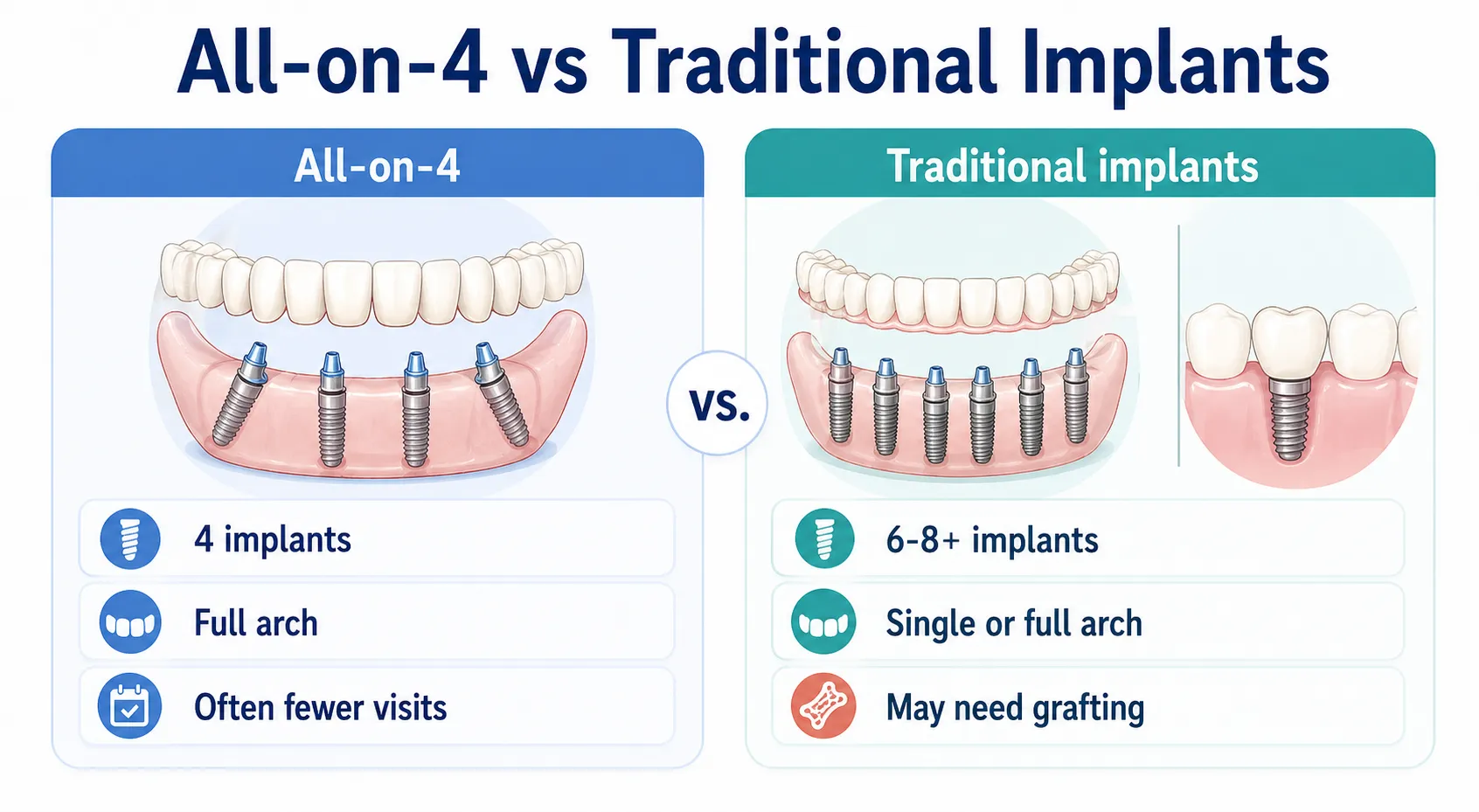 Here’s a quick comparison to help you see the key differences:
| All-on-4 | Traditional Implants | |
|---|---|---|
| Implants per Arch | 4 | 6 to 8 or more |
| Bone Grafting | Rarely needed | Often required |
| Surgery Complexity | Less invasive, fewer procedures | More complex with potentially multiple procedures |
| Time to New Teeth | Same day (temporary) | Months |
| Cost | $12,000 to $25,000 per arch | $3,000 to $4,500 per tooth$18,000 to $36,000 per arch |
Is All-on-4 Right for Me?
The best way to find out if you’re a good candidate is to talk to a qualified dental implant specialist in your area.
But in general, if you’re missing most or all of your teeth in one or both arches and are tired of the inconvenience of dentures, All-on-4 might be an excellent option.
What Happens During the All-on-4 Procedure?
Planning, healing, and getting your permanent prosthesis can take six months to a year. Healing times vary, and sometimes unexpected things, like the need for bone grafting, can add a bit of time.
The All-on-4 process follows five main stages, from initial consultation through final prosthesis placement:
1. Consultation
The first step is meeting with a dentist specializing in dental implants. During the consultation, your dentist will do the following:
- Examine your mouth
- Take X-rays and possibly 3D scans
- Listen to your goals
- Create a personalized treatment plan
The consultation is your chance to learn more about the procedure, so don’t forget to ask questions.
2. Bone Grafting
While the All-on-4 is designed to minimize the need for bone grafting, sometimes extra support is needed. However, the All-on-4 procedure still often requires less extensive bone grafting compared to traditional implants.
3. Surgery
On surgery day, you’ll usually receive sedation to make the procedure completely comfortable. Your dental surgeon will first remove any remaining teeth in the arch.
Then, they’ll place four special implants—two at the front of your mouth and two angled towards the back.
4. Immediate Provisional Restoration
After the implant placement, you’ll receive a temporary prosthetic. This allows you to leave the office with a functional and aesthetically pleasing smile.
The temporary aesthetic restores your ability to eat and speak. It also aids in the healing process by supporting your gums.
5. Osseointegration and Healing
Over the next few months, your jawbone will fuse with the dental implants in a process called osseointegration.
During this crucial healing period, you’ll continue to wear the temporary prosthetic, which helps maintain your smile and facilitates the integration of the implants.
6. Permanent Prosthetic Placement
Once osseointegration is complete and your implants are fully integrated with your jawbone, you’ll return to the dental office for the final step.
Your dentist will replace the temporary prosthetic with a custom-made, permanent prosthetic. This crafted set of teeth is designed to seamlessly blend with your natural smile, offering optimal function, comfort, and aesthetics.
Call your dentist right away if you notice pain, swelling, redness, or bleeding around your implants.
How to Maintain and Care for All-on-4 Dental Implants
Once you’ve completed the procedure, you’ll want to ensure your new teeth last. Remember that your implants are like real teeth—they’ll also need proper care.
Good oral hygiene, including regular brushing and flossing, will make the implants last longer while keeping surrounding teeth healthy.
Here are our tips for keeping good oral hygiene:
- Use a soft-bristled brush and non-abrasive toothpaste.
- Brush gently all around the implants, especially where they meet the gums.
- Floss around each implant daily as well. Special flosses are made just for implants–you can ask your dentist about it.
- Quit smoking and wear a mouthguard to make your implants longer.
- Avoid hard or sticky foods that can put too much force on your implants.
Visiting your dentist for checkups and cleanings is also key. Most people with All-on-4 implants need a visit every 3 to 6 months. Your dentist will closely monitor the health of your implants and gums so they can fix potential issues early.
As time goes on, the prosthesis will eventually wear out. Visit your dentist regularly so they can check when it might be time to replace it.
All-on-4 dental implants offer a faster, less invasive, and often more affordable solution than traditional implants. While they offer significant advantages, it’s crucial to consult a dental professional to determine if they fit your needs.
Sources
- “Implants” The American Dental Association.
- “Dental Treatments” National Health Service.
- “Dental Implants FAQ” American College of Prosthodontists.
- Grandi T & Signorini L. “Rehabilitation of the Completely Edentulous Mandible by All-on-Four Treatment Concept: A Retrospective Cohort Study with Up to 10 Years Follow-Up” Medicina, 2021.
- “Dental Implants” Cleveland Clinic, 2020.
- “Types of Implants & Techniques” American Academy of Implant Dentistry.
- Soto-Penaloza et al. “The all-on-four treatment concept: Systematic review.” J Clin Exp Dent, 2017.
- Taruna et al. “Prosthodontic perspective to all-on-4® concept for dental implants.” J Clin Diagn Res, 2014.

Licensed dental specialist focusing on personalized dental content writing and blogging.

Medical contributor passionate about cosmetic dentistry and simplifying complex topics.
Related Articles
Types of Dental Implants: Procedure, Materials, and How They Work
What are dental implants, and how do they work? We cover the basics—from the types of implants to the procedure, costs,...
3 on 6 Dental Implants
3 on 6 dental implants are recommended for people who are missing most of their teeth. Learn more about 3 on 6 implants,...

What is an Abutment for Dental Implants?
An abutment connects a dental implant to the crown that replaces the tooth. This article talks about abutments, their ty...

All-on-Four Dental Implants
ClearChoice is the leading provider of dental implants. Learn about their benefits, how they work, and what to expect fr...