How To Replace a Missing Tooth?


Reader-supported. We may earn a commission from links on this page. Advertising disclosure.
In this article
Missing teeth aren’t just a cosmetic issue. They can affect chewing, speaking, and even self-confidence.
Fortunately, several options exist to replace a missing tooth. Below you’ll find how dental implants, bridges, and dentures compare, along with factors to consider when choosing a solution.
What’s the Best Way to Replace a Missing Tooth?
The best option for you depends on your oral health, the condition of your jawbone, your budget, and your personal preference. Some of the treatments you can choose to have include:c
- Dental implants — An implant involves surgically inserting a titanium post into your jawbone to act as a new root for your tooth.
- Dental bridges — A popular option for replacing one or several teeth. They bridge the gap by using crowns on both sides of the missing tooth to support a false tooth.
- Dentures — Dentures are removable, hybrid, or permanent replacements for missing teeth and surrounding tissue. They can be complete or partial dentures.
Here are some pros and cons you should consider when choosing a replacement option:
| Pros | Cons | |
|---|---|---|
| Dental implants | Natural look and feel, restores smile and functionality, long-term solution that can last a lifetime, prevents bone loss | Long procedure requiring multiple sessions, lengthy healing time, high cost |
| Dental bridges | Restores smile and functionality, can last for several years depending on materials and care, less invasive compared to implants | Requires adjacent teeth for support, requires reshaping of healthy teeth, not ideal for replacing back molars |
| Dentures | Less invasive, lower cost for removable, useful for extensive tooth loss | Adjustment period to get used to dentures, requires daily care, can’t prevent bone loss |
If you want a personalized recommendation, we suggest talking to a dentist or a prosthodontist (a specialist in tooth replacement solutions).
What Should You Consider When Replacing Teeth?
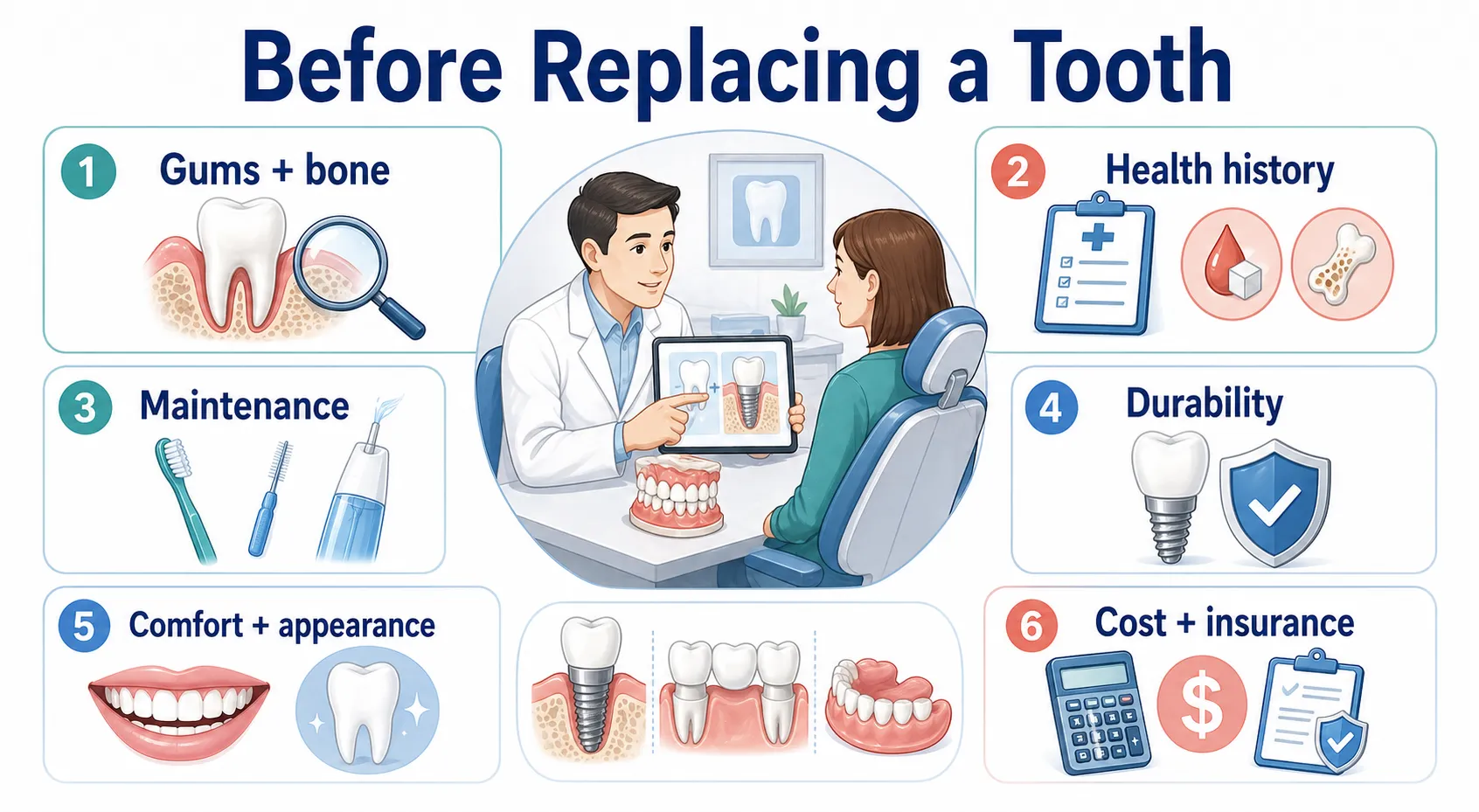
Ideally, you should get a thorough evaluation or consultation before deciding on a replacement option. A dentist will examine your gums, bone density, and overall health to determine which option best suits you.
Some underlying health conditions like diabetes or osteoporosis can also affect the success of procedures like dental implants. Because of that, it’s important to disclose your full medical history to a dentist.
Other things you might want to consider include:
- Maintenance — Some options require meticulous care, and some need to be replaced. Consider how much maintenance you’re comfortable with in your daily routine.
- Durability — If you’re very active, you might want to consider a more stable and durable replacement option.
- Comfort —Talk to your dentist about how comfortable you are with certain procedures and options, especially if they affect your daily life.
- Aesthetics — If your missing tooth is visible, you might want to consider options that match your natural teeth.
- Preserving facial structure — Some options, like dental implants, prevent your jawbone from shrinking. This can help maintain your facial structure and confidence.
- Cost — The upfront cost of dental replacements can vary depending on your dentist and their location. Ask your dentist for a detailed cost breakdown and see if your insurance can cover the procedure.
What is a Tooth Replacement Process Like?
Understanding how these tooth replacement options work can help give you an idea of which option to choose. Here’s a breakdown of the replacement process:
Dental Implants
Dental implants replace the missing tooth with a new root and crown, making it function like a natural tooth. After consultation with your dentist, they’ll assess your jawbone density using X-rays or 3D scans and create a personalized treatment plan.
Here’s a step-by-step breakdown of the procedure:
- Implant placement — Your dentist will numb the area with local anesthesia. A small incision will be made in your gum before the implant is placed on your bone.
- Healing and osseointegration — Your implant can take several months to heal. During this time, your bone fuses with the implant (osseointegration), creating a solid foundation.
- Abutment placement — Once your bone has fully integrated with the implant, a minor procedure is performed to attach a small connector piece atop the implant.
- Final crown placement — In the final stage, a custom-made crown matching your natural teeth is attached to the abutment to complete the procedure.
After the procedure, you can expect some discomfort and swelling. This can be managed with over-the-counter pain medication and ice packs.
Most people can return to their usual activities within a few days. For aftercare, brush and floss your teeth, and visit your dentist regularly for checkups and cleanings.
Dental Bridges
Similar to implants, dental bridges begin with a consultation and assessment. The dentist will assess your overall health and discuss your needs to determine if the procedure is right for you.
They will also take x-rays of your teeth to evaluate the condition of adjacent teeth and bone structure. Based on the examination, your dentist will create a personalized treatment plan and take impressions of your teeth.
The process for dental bridges involves:
- Numbing — The dentist numbs the area with a local anesthetic and prepares the abutment teeth, also known as the teeth adjacent to the missing teeth.
- Shaping — Involves removing a portion of the enamel to make room for the crowns supporting the bridge.
- Impressions — Impressions or digital scans of your teeth are taken and sent to a dental laboratory to fabricate the custom bridge.
- Temporary bridge — While the permanent bridge is being made, a temporary bridge is placed to protect the prepared teeth and maintain aesthetics and functionality.
- Permanent bridge — The dentist checks the fit and appearance of the new bridge. They can also make adjustments to ensure a comfortable fit and proper bite alignment.
- Cementation — Once everything is in order, the permanent bridge is cemented in place using dental cement.
- Final adjustments — The dentist makes final adjustments to ensure the bridge fits comfortably and doesn’t interfere with your bite.
After the procedure, remember to go to follow-up appointments to maintain your dental bridge. Follow your dentist’s aftercare instructions to prevent complications like dislodging the temporary bridge. Avoid sticky or hard foods that can damage the bridge.
Dentures
During the initial consultation, they’ll also examine your oral health to determine if dentures are right for you. They may take a panoramic x-ray and initial impressions of your mouth to evaluate the condition of your teeth, gums, and bone.
If you have any remaining unhealthy teeth, the dentist may need to extract them. This is crucial for the dentures to properly and comfortably fit. Here’s what the process for dentures looks like:
- Impressions — Used to create a precise mold of your mouth to make custom-fit dentures.
- Bite registration —The dentist also records how your upper and lower jaws relate to each other, which helps ensure that the dentures will fit together correctly.
- Wax try-in — A wax model that allows you and the dentist to check your dentures’ fit, bite, and appearance. It also helps them check for necessary adjustments.
- Final denture fabrication — The wax model is then replaced with an acrylic model, trimmed, and polished for a smoother finish.
- Initial fitting and adjustment — The initial fitting helps address any sore spots or discomforts and adjust them as necessary in follow-up visits.
Once you have your dentures, the dentist will provide detailed instructions on caring for them, including cleaning and maintenance tips. You should also regularly visit your dentist to monitor the condition of your dentures, gum health, and bone.
Are These Tooth Replacement Solutions Safe?
All three tooth replacement options are considered safe and effective. But like any other procedure, they come with potential risks.
We created a table of the possible issues that can arise with each treatment, helping you make an informed decision about the best tooth replacement solution for your needs.
| Potential Risks and Complications | |
|---|---|
| Dental Implants | Infection, failed osseointegration, bone and gum issues, implant fracture, screw loosening |
| Dental Bridges | Recurrent tooth decay, gum disease, allergic reactions, bridge failure, misalignment |
| Dentures | Bone loss, loss of retention, gum irritation and infection, difficulty eating and speaking, changes in taste, oral thrush |
Replacing a missing tooth is an important part of maintaining oral health, functionality, and confidence.
Dental implants, bridges, and dentures effectively replace missing teeth. Understanding the pros and cons of tooth replacement options can help you decide which ones are best for you.
Sources
- Topić et al. “Adaptation to New Dentures and 5 Years of Clinical Use: A Comparison between Complete Denture and Mini-implant Mandibular Overdenture Patients based on Oral Health-Related Quality of Life (OHRQoL) and Orofacial Esthetics.” Acta Stomatol Croat, 2022.
- Gupta et al. “Dental Implants.” Treasure Island (FL): StatPearls Publishing, 2023.
- Dăguci et al. “Considerations on dental bridges' stability and balance for mandibulary teeth with coronary-root amputation.” Curr Health Sci J, 2012.
- Alenezi A. & Aloqayli S. “Technical complications with tooth-supported fixed dental prostheses (FDPs) of different span lengths: an up to 15-year retrospective study.” BMC Oral Health, 2023.
- Kochar et al. “The Etiology and Management of Dental Implant Failure: A Review. Cureus, 2022.
- Bilhan et al. “Complication rates and patient satisfaction with removable dentures.” J Adv Prosthodont, 2012.
- Setzer F. & Kim S. “Comparison of long-term survival of implants and endodontically treated teeth.” J Dent Res, 2014.

Board-certified general dentist specializing in patient education and preventive dentistry.

Web content writer specializing in making dental research accessible to diverse audiences.
Related Articles

The Importance of Aesthetic Dentistry
Aesthetic dentistry is focused on enhancing the appearance of your smile. The practice is about much more than just whit...
What Is Digital Smile Design?
Digital Smile Design (DSD) lets you preview your new smile before treatment begins. Learn how it works, what it costs, a...

Fake Braces: Are They Worth the Risk?
Are "fashion braces" the real deal? Those ads and influencers flashing smiles with colorful bands and wires may look ent...

Is Ohaguro Still Practiced Today?
The practice of teeth blackening, or ohaguro, has a deep and complex history worldwide. While it was initially jarring t...