Types of Dental Implants and How Much Each One Costs


Reader-supported. We may earn a commission from links on this page. Advertising disclosure.
In this article
A single dental implant costs $3,000 to $5,600, and a full-mouth restoration runs $38,600 to $90,000. Where you land depends on the type of implant, your bone health, the materials chosen, and where you live.
This guide compares the seven implant options patients are quoted for today, names the 2026 price range for each, and shows the cost drivers that move those numbers up or down.
How Much Do Dental Implants Cost by Type?
The table below shows typical 2026 patient prices for each implant type, with the sources that anchor each range.
| Implant Type | Typical Cost (2026) | Best For |
|---|---|---|
| Single tooth implant | $3,000–$5,600 per tooth1,8 | One missing tooth |
| Implant-supported bridge | $4,000–$16,0002 | Two to four adjacent missing teeth |
| Implant-retained denture | $2,000–$13,300 per arch3 | Full-arch tooth loss, removable preferred |
| 3-on-6 dental implants | $9,700–$24,100 per arch4 | Full-arch, fixed, mid-budget |
| All-on-4 | $11,600–$27,500 per arch5 | Full-arch fixed on four implants |
| Full-mouth implants | $38,600–$90,0003 | Both arches, comprehensive |
| Zygomatic implants | $3,018–$7,357 per implant component; full upper-arch reconstruction quoted case-by-case6 | Severe upper-jaw bone loss |
How we sourced these prices: Ranges reflect public 2025–2026 patient-pricing data from Delta Dental,1 Aspen Dental’s 2026 patient pricing,3,8 CareCredit’s procedure cost guides published in 2025 and 2026,2,4,5,6 and the American Association of Oral and Maxillofacial Surgeons (AAOMS).12 Prices are list estimates, not patient out-of-pocket costs after insurance. Real prices vary by region, dentist experience, materials, and case complexity. Consult a local implant dentist for a written treatment plan.
Cost of Each Implant Type in Detail
Single Tooth Implant Cost ($3,000–$5,600)
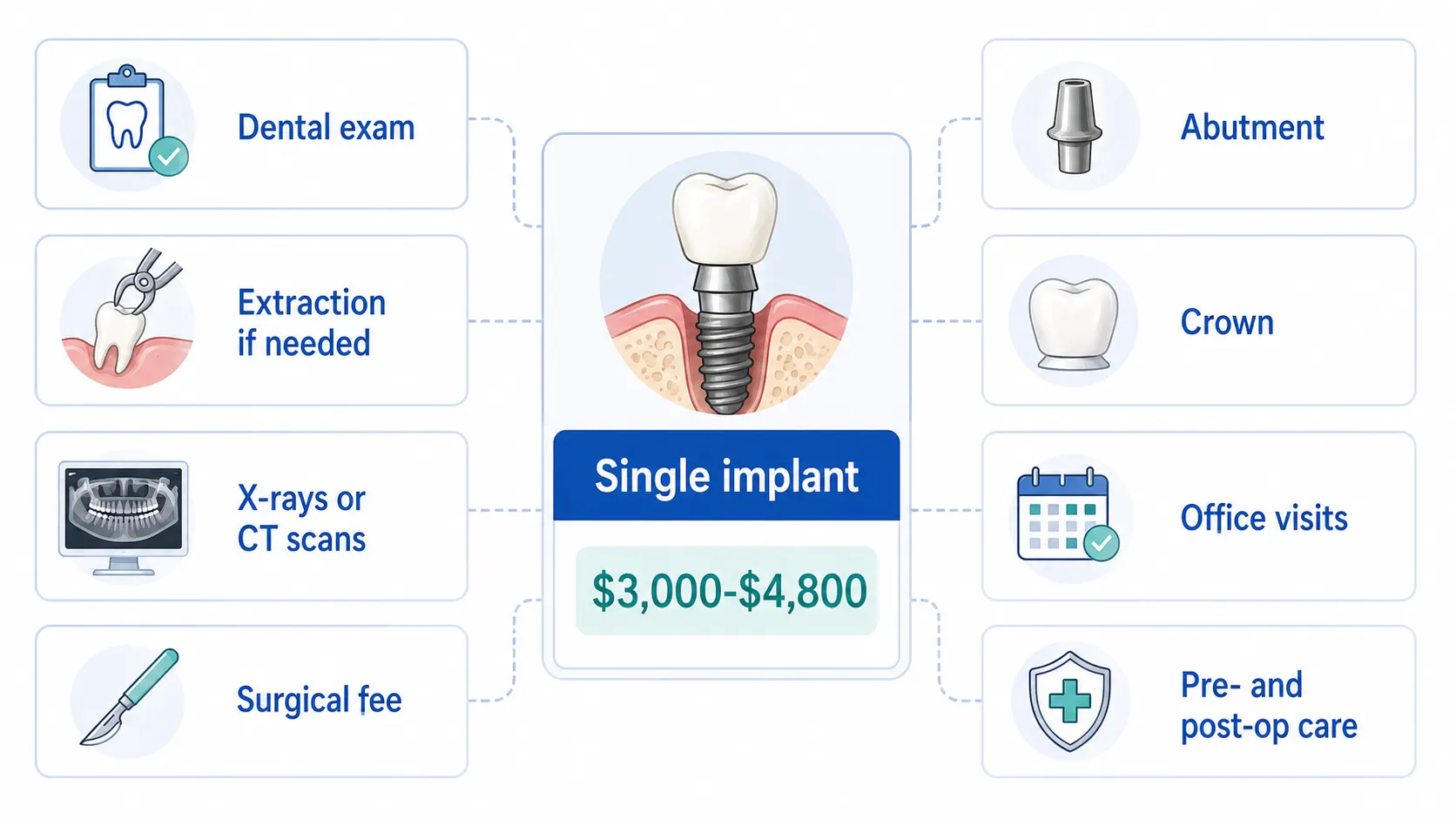
A single-tooth implant replaces one missing tooth with a titanium post, an abutment, and a crown — a single unit that looks and functions like a natural tooth.7
Delta Dental puts the typical package at $2,800 to $5,600, averaging around $3,700 for most patients.1 Aspen Dental’s 2026 provider data shows a range of $3,158 to $6,533 with an average of $4,259.8 The package usually covers the implant post, the abutment that connects the implant to the crown, and the crown itself.1
What is often billed separately: tooth extraction (if the failed tooth is still in place), bone grafting, sinus lift, CT scans, pre- and post-op visits, and IV sedation. Each adds to the total. Your complete dental implant procedure bill typically includes CDT codes D6010 (surgical implant placement), D6011 (second-stage surgery if needed), D6056 (prefabricated abutment), and D6058–D6065 (implant-supported crown variants).9
Implant-Supported Bridge Cost ($4,000–$16,000)
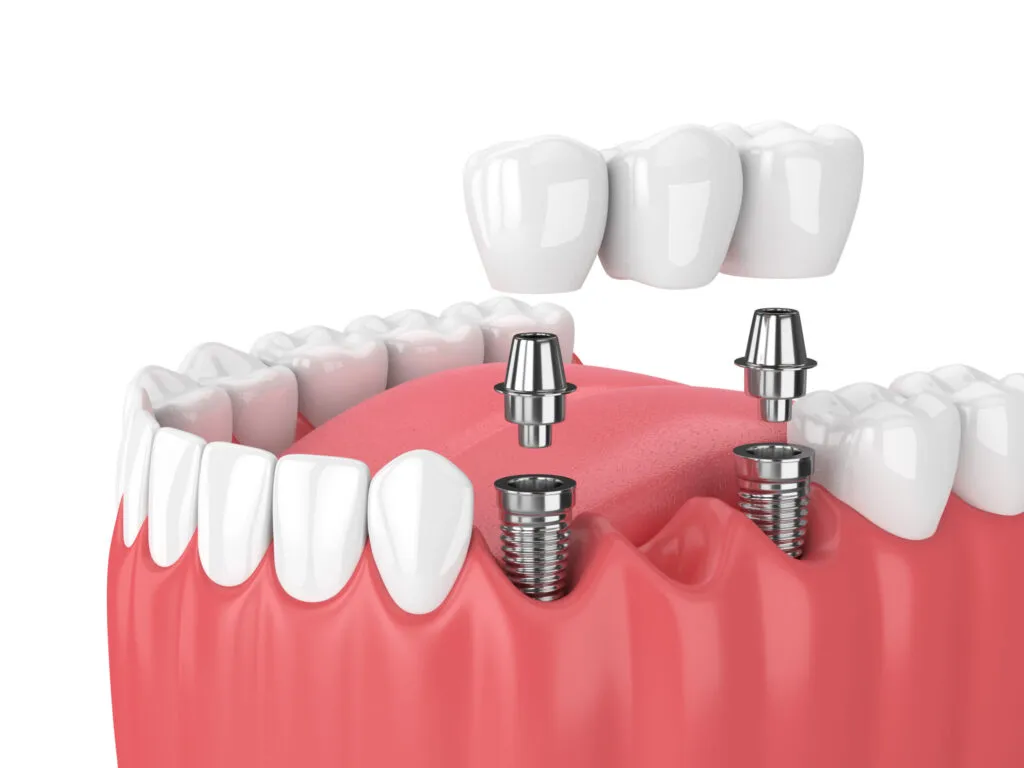
An implant-supported bridge replaces two to four adjacent missing teeth using two implants as anchors, with a row of false teeth between them.7 It is a fixed, non-removable option that does not require shaving down neighboring teeth.
CareCredit reports an average implant-supported bridge cost around $5,200, with complex multi-tooth bridges reaching $16,000 or more.2 The wider range reflects how many teeth the bridge spans, the materials selected (porcelain-fused-to-metal versus full zirconia), and whether bone grafting is needed at the implant sites. The trade-off: the false teeth in the middle of the bridge are not anchored directly to the jawbone, so the bone underneath them shrinks over time.
Implant-Retained Denture Cost ($2,000–$13,300 per arch)
An implant-retained denture — sometimes called a snap-on denture — is a removable full-arch prosthetic secured by two to four implants per arch. It offers more stability than a traditional denture without the cost of a fully fixed arch.7
Aspen Dental’s 2026 provider data lists implant dentures at $7,628 to $13,297 per arch with an average near $8,300.3 Lower ranges of $2,000 to $5,000 per arch typically reflect mini-implant-retained removable systems. See our implant-supported denture guide and our mini-implants guide for the lower-cost variants.
3-on-6 Dental Implant Cost ($9,700–$24,100 per arch)
The 3-on-6 dental implant system places six implants per arch to support a three-section fixed bridge, replacing all teeth in one arch with a prosthetic that does not come out. It distributes chewing forces more evenly than All-on-4 and lets the dentist replace individual bridge sections later if needed.
CareCredit’s November 2025 cost guide shows $9,708 to $24,091 per arch, averaging $12,474.4 The wide range reflects material choices (acrylic versus zirconia prosthetics) and the number of preparatory procedures required. It costs more than All-on-4 because the case uses six implants instead of four.
All-on-4 Implant Cost ($11,600–$27,500 per arch)
The All-on-4 system anchors a full-arch fixed prosthesis to four implants per jaw, with the back two angled to maximize bone contact. The angled rear implants work with available bone and often eliminate the need for bone grafting.
CareCredit’s April 2026 data shows $11,640 to $27,500 per arch, averaging $15,176.5 A full-mouth two-arch case typically runs $24,000 to $55,000. All-on-4 is often the most cost-effective fixed full-arch option because it uses fewer implants than 3-on-6 or traditional implant bridges. Same-day provisional teeth — sometimes marketed as “teeth in a day” — are possible when the implants achieve enough initial stability at placement, but not every case qualifies; some patients need a healing period before the final prosthesis is fitted. The clinical concept is supported by systematic-review evidence.10
Full-Mouth Dental Implant Cost ($38,600–$90,000)
A full-mouth implant restoration replaces every tooth in both arches with implant-supported prosthetics. Aspen Dental’s 2026 data lists fixed full-arch implants at $19,315 to $30,878 per arch, which implies roughly $38,600 to $61,800 for two arches in that provider dataset.3
Premium full-mouth reconstruction using individual crown-on-implant restorations — rather than a single fixed-arch bridge — sits at the top of the range. An upper-arch reconstruction can require 10 to 14 implants; a lower arch, 8 to 10. Those cases, often combined with zirconia bridges and advanced grafting, run $60,000 to $90,000 or more depending on the number of implants placed and the materials used.
Zygomatic Implant Cost
Zygomatic implants are extra-long implants anchored in the cheekbone (zygoma) rather than the upper jaw. They are used for severe upper-jaw bone loss when standard implants are not viable, and they often avoid the need for major bone grafting.11
CareCredit lists per-implant zygomatic component costs at $3,018 to $7,357, with an average of $3,918.6 Most patients need two to four zygomatic implants per upper arch, often combined with conventional implants in the front of the jaw, so a full upper-arch zygomatic reconstruction is quoted case-by-case. Specialist training adds significantly to the surgeon’s fee; Straumann and Nobel Biocare offer the two most widely used zygomatic systems. Ask your oral and maxillofacial surgeon for a specific written estimate that lists each component.
What Affects the Cost of Dental Implants?
Six factors move the final price more than anything else. The AAOMS lists location, surgical fees, extractions, anesthesia, bone grafting, X-rays, materials, crown placement, number of teeth replaced, and insurance limits as the core cost drivers.12
Location: Dental fees in major metro areas run 30% to 50% higher than in smaller markets, and big-city practices can list 2 to 3 times the rural rate. A single-tooth implant that costs $3,000 in a rural practice can list at $5,500 in a coastal urban market. The ADA Health Policy Institute tracks regional fee variation by CDT code; ask your dentist for a regional estimate.
Implant materials: Titanium implant posts are the standard and typically the least expensive. Zirconia ceramic posts cost more but are metal-free, which matters to some patients — sometimes adding $500 to $1,500 to a single-tooth case. Crown materials range from porcelain-fused-to-metal (least expensive) to monolithic zirconia (mid-tier) to layered all-ceramic (most expensive). The FDA confirms both titanium and zirconia oxide as approved implant materials.13
Dentist’s experience: Periodontists and oral surgeons with implant fellowships charge more than general dentists. That premium reflects training and volume that reduces complication risk — a reasonable trade-off for a multi-stage surgery, and particularly worth paying for zygomatic and complex full-arch work.
Procedure complexity: Bone-graft pricing depends on graft type and timing, and the CDT code on your estimate tells you which procedure is being billed. Ridge preservation after a tooth is removed is usually billed as D7953; grafting placed at the same time as the implant is billed as D6104; ridge augmentation or sinus augmentation done in preparation for future implants uses codes such as D7950, D7951, or D7952.9,14 Bone-graft fees commonly run $549 to $5,148 per site depending on which of those procedures you actually need.14 Sinus augmentation — placed when the upper jaw lacks the bone height for an implant — adds surgical time and several hundred to several thousand dollars to the total.15 Ask the office to confirm whether the quoted graft fee covers socket preservation, ridge augmentation, or sinus augmentation before you sign a treatment plan.
Sedation: Oral sedation runs $200 to $500. IV sedation adds $500 to $1,200. General anesthesia costs more and is reserved for full-arch surgical days or anxious patients.
Number of teeth replaced: Each added implant raises the surgical fee, the prosthetic component fee, and the imaging fee. Replacing four teeth with individual implants costs more than replacing the same four teeth with a 2-implant bridge.
Ask the office for a CDT-coded treatment plan so you can compare quotes line by line across practices.
What Is the Cheapest Way to Get Dental Implants?
The cheapest legitimate paths to implants are mini-implants, implant-retained dentures, and university dental school clinics.
- Mini-implants — Smaller-diameter implants used mainly to stabilize lower dentures. Mini-implant systems for a single arch typically fall in the $2,000 to $5,000 range. Best suited for patients with adequate bone in the front of the jaw who want removable stability without full-arch surgery costs. See our mini-implants guide.
- Implant-retained dentures — Two or four implants per arch holding a removable denture cost much less than a fixed full-arch restoration.
- University dental school clinics — Many dental schools complete implant placements at 30% to 70% below private-practice rates, performed by supervised students under licensed faculty. Treatment takes longer, but safety standards are maintained.
- Dental discount plans — Annual-fee membership plans (not insurance) discount most dental procedures by 10% to 60% at participating dentists. No annual maximum, no waiting period.
- Low-income and community programs — Federally Qualified Health Centers and nonprofit clinics serve patients without insurance on a sliding scale. See our low-income dental implants resource and our low-cost implants guide for state-by-state options.
Be cautious of pricing that looks dramatically below the public ranges in this article. Implant failure is real, and revision work costs more than the original case. Our implant failure guide covers what goes wrong when cases are rushed or under-planned. Dental tourism saves money for straightforward cases, but follow-up care if something goes wrong is harder to coordinate from abroad — verify the provider’s credentials and confirm they use name-brand implant systems (Straumann, Nobel Biocare, Zimmer Biomet) that U.S. dentists can service.
Does Dental Insurance Cover Implants?
Dental plans that include major restorative coverage pay up to 50% of the covered procedure cost, subject to annual maximums of $1,000 to $2,500.16,17 Because implants are expensive, most patients are not fully covered by a single plan year’s benefit — meaning implants frequently span two plan years deliberately, or patients pay the bulk out-of-pocket.
Three caveats matter:
- What’s covered varies by plan. Some plans cover the crown and abutment (the restorative portion) but exclude the surgical placement of the implant body. Others exclude implants entirely. Read the Summary of Benefits, waiting periods (often 6 to 12 months for major restorative), and preauthorization rules before scheduling.
- Annual maximums bottleneck payouts. A $1,500 annual maximum against a $4,000 single-tooth implant leaves $2,500 out-of-pocket even with 50% coverage, because the 50% only applies up to the plan’s annual cap.
- Medical insurance rarely covers implants. Medicare Part A and Part B do not cover routine dental implants. Medicare Advantage plans sometimes offer limited dental benefits; original Medicare does not.18 Coverage is possible when implants are part of reconstructive treatment after an accident or cancer surgery.
For deeper coverage details, see our dental implant insurance guide.
How to Pay for Dental Implants Without Insurance
If insurance won’t cover your case, five payment paths reduce the out-of-pocket cost.
- FSA and HSA accounts — Flexible spending and health savings accounts let you pay for eligible dental expenses with pre-tax dollars. IRS Publication 502 covers most medically necessary dental treatment, including implants for the treatment or prevention of dental disease; cosmetic-only work is excluded.19 A 24% tax bracket effectively gives you a 24% discount on covered work.
- CareCredit and similar financing — Healthcare credit products offer 6- to 24-month interest-free periods on qualifying balances, with longer-term plans available at standard interest rates. Many implant practices accept CareCredit and offer promotional 0% interest periods for qualifying patients.
- Dental discount plans — Annual-fee membership plans (DentalPlans, Careington, and similar) provide pre-negotiated fee reductions at participating dentists. Not insurance, but useful for patients without employer-sponsored dental coverage.
- In-office payment plans — Many implant practices offer 12- to 60-month in-house financing, sometimes interest-free for the first 12 months. Ask the dentist directly.
- University clinic programs — Dental schools charge reduced fees on implant cases performed by supervised students. The trade-off is longer treatment timelines.
When to See a Dentist
Schedule a consultation when you have one or more missing teeth, you are losing bone in the jaw where teeth are gone, or your existing dentures slip and make eating difficult. The sooner you see a dentist after tooth loss, the more bone you typically have available — which simplifies placement and can reduce the need for a bone graft. A consultation usually includes a CT scan or panoramic X-ray, a bone-density evaluation, and a written treatment plan with itemized costs.
Bring these questions to your first appointment:
- Am I a candidate based on my bone level, gum health, smoking status, diabetes control, and any medications or treatments that affect bone healing — such as antiresorptive drugs, steroids, chemotherapy, or head-and-neck radiation?
- Which implant type fits my missing teeth and budget?
- What does the total treatment cost include, and what is billed separately?
- Do you accept my insurance, and will your office verify my benefits before treatment?
- What is your experience with this specific procedure?
Bring three things to the consultation: your dental insurance details (or a note that you are paying out of pocket), a list of medications you take, and any prior dental work records the office can review. Ask for the CDT codes on the treatment plan so you can compare quotes across practices.
If cost is the primary barrier, ask about phased treatment — many dentists can extract or prepare in one phase and place the implant in a later phase that falls in a new insurance plan year, maximizing your benefit. For the full procedure, healing timeline, candidacy criteria, and alternatives, see our implants hub.
Sources
Sources
- Delta Dental. Understanding Dental Implant Costs and Insurance Coverage. Accessed May 18, 2026.
- CareCredit. Dental Implants Cost and Procedure Guide. Posted March 14, 2025.
- Aspen Dental. How Much Do Full Mouth Dental Implants Cost?. 2026 internal patient pricing data. Accessed May 18, 2026.
- CareCredit. 3 on 6™ Dental Implants Cost and Procedure Guide. Published November 21, 2025.
- CareCredit. All-on-4 Dental Implants Cost and Procedure Guide. Published April 24, 2026.
- CareCredit. Zygomatic Dental Implants Cost and Procedure Guide. Published 2026.
- American Academy of Implant Dentistry. Demystifying Dental Implants. Accessed May 18, 2026.
- Aspen Dental. How Much Do Dental Implants Cost?. 2026 internal patient pricing data. Accessed May 18, 2026.
- American Association of Oral and Maxillofacial Surgeons. Coding for Oral Implants. Accessed May 18, 2026.
- Soto-Penaloza et al. “The all-on-four treatment concept: Systematic review.” Journal of Clinical and Experimental Dentistry, National Library of Medicine, 2017.
- Polido WD, Machado-Fernandez A, Lin WS, Aghaloo T. “Indications for Zygomatic Implants: A Systematic Review.” International Journal of Implant Dentistry, 2023;9:17.
- American Association of Oral and Maxillofacial Surgeons. How Much Are Dental Implants? MyOMS. Updated July 2023.
- U.S. Food and Drug Administration. Dental Implants: What You Should Know. Updated October 29, 2021.
- CareCredit. Dental Bone Graft Cost and Procedure Guide. Published February 7, 2025.
- American Association of Oral and Maxillofacial Surgeons. Sinus Augmentation: Preparing Sinuses for Dental Implants. MyOMS. Accessed May 18, 2026.
- Guardian. Dental Implant Insurance. Accessed May 18, 2026.
- MetLife. Does Dental Insurance Cover Implants? Accessed May 18, 2026.
- Centers for Medicare & Medicaid Services. Dental Services Coverage. Accessed May 18, 2026.
- Internal Revenue Service. Publication 502: Medical and Dental Expenses. 2025.

Board-certified general dentist specializing in patient education and preventive dentistry.

Experienced content writer dedicated to delivering accurate, unbiased dental information.
Related Articles
Types of Dental Implants: Procedure, Materials, and How They Work
What are dental implants, and how do they work? We cover the basics—from the types of implants to the procedure, costs,...
3 on 6 Dental Implants
3 on 6 dental implants are recommended for people who are missing most of their teeth. Learn more about 3 on 6 implants,...

What is an Abutment for Dental Implants?
An abutment connects a dental implant to the crown that replaces the tooth. This article talks about abutments, their ty...
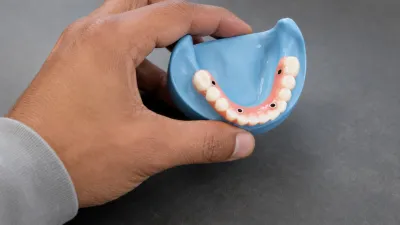
Should I Get All-on-4 Dental Implants?
If you have missing teeth and want full functionality of your mouth back, All-on-4 dental implants may be right for you....