Does Charcoal Toothpaste Work?


Reader-supported. We may earn a commission from links on this page. Advertising disclosure.
In this article
Charcoal toothpaste has become a popular choice, showing up on social media feeds and store shelves with bold whitening promises. The marketing is persuasive, but the facts about charcoal toothpaste tell a different story. This article looks at what current research says about whether charcoal whitens teeth, what risks it poses, and which alternatives actually have scientific backing.
Does Charcoal Toothpaste Work?
Current research does not support charcoal toothpaste as an effective whitener. Systematic reviews examining charcoal toothpaste facts consistently find that it performs no better than regular fluoride toothpaste on objective color measures.
- A 2023 systematic review of 11 studies found that charcoal toothpastes showed lower whitening effects than other options, with most of the available evidence rated at medium to high risk of bias.
- A 2024 clinical trial reinforced that conclusion, finding no clinically meaningful improvement in tooth color over regular fluoride toothpaste. Any whitening produced by charcoal appears to result from abrasion. This means it scrubs away surface stains rather than bleaching intrinsic tooth color. That distinction matters because abrasion carries its own risks. Ask your dentist which whitening method fits your teeth and budget.
How Charcoal Harms Enamel
Charcoal toothpaste can be abrasive enough to damage enamel, the hard outer layer that protects your teeth. A standard scale called Relative Dentin Abrasivity (RDA) measures how much a toothpaste wears down tooth surfaces. It showed that charcoal toothpastes ranged from 24 to 166 across 12 products tested in a 2023 study. Enamel does not grow back once it wears away. As enamel thins, it exposes dentin, the softer, yellow layer beneath, making teeth look more discolored and become more sensitive. If you’ve been using charcoal toothpaste and notice sensitivity, schedule a dental exam.
The Opposite Effect
Abrasion from charcoal can roughen the outer surface of your teeth. Rougher surfaces collect more biofilm and staining compounds, so charcoal toothpaste can worsen future discoloration rather than improve it. Fine charcoal particles can also get stuck in tiny cracks or pits in the enamel, leaving behind dark specks that are difficult to remove.
The Fluoride Gap
Most charcoal toothpastes don’t contain fluoride, the ingredient most proven to prevent cavities. One survey found that only about 8% of charcoal products included fluoride. The ADA requires fluoride for any toothpaste that makes cavity-prevention claims, and no charcoal toothpaste has earned the ADA Seal of Acceptance. Research also suggests charcoal can bind to fluoride, potentially reducing its effectiveness even in products that do contain it.
What is Activated Charcoal?
Activated charcoal is a fine black powder made by heating carbon-based materials, such as wood or coconut shells, to very high temperatures. The process creates a surface full of tiny holes, giving charcoal a strong ability to trap certain substances. People have used various forms of charcoal in oral hygiene for centuries, with records reaching back to ancient Egypt and Greece. The version sold in toothpastes today is processed very differently from grilling charcoal and is not the same product.
Charcoal Toothpaste: Claims vs. Evidence
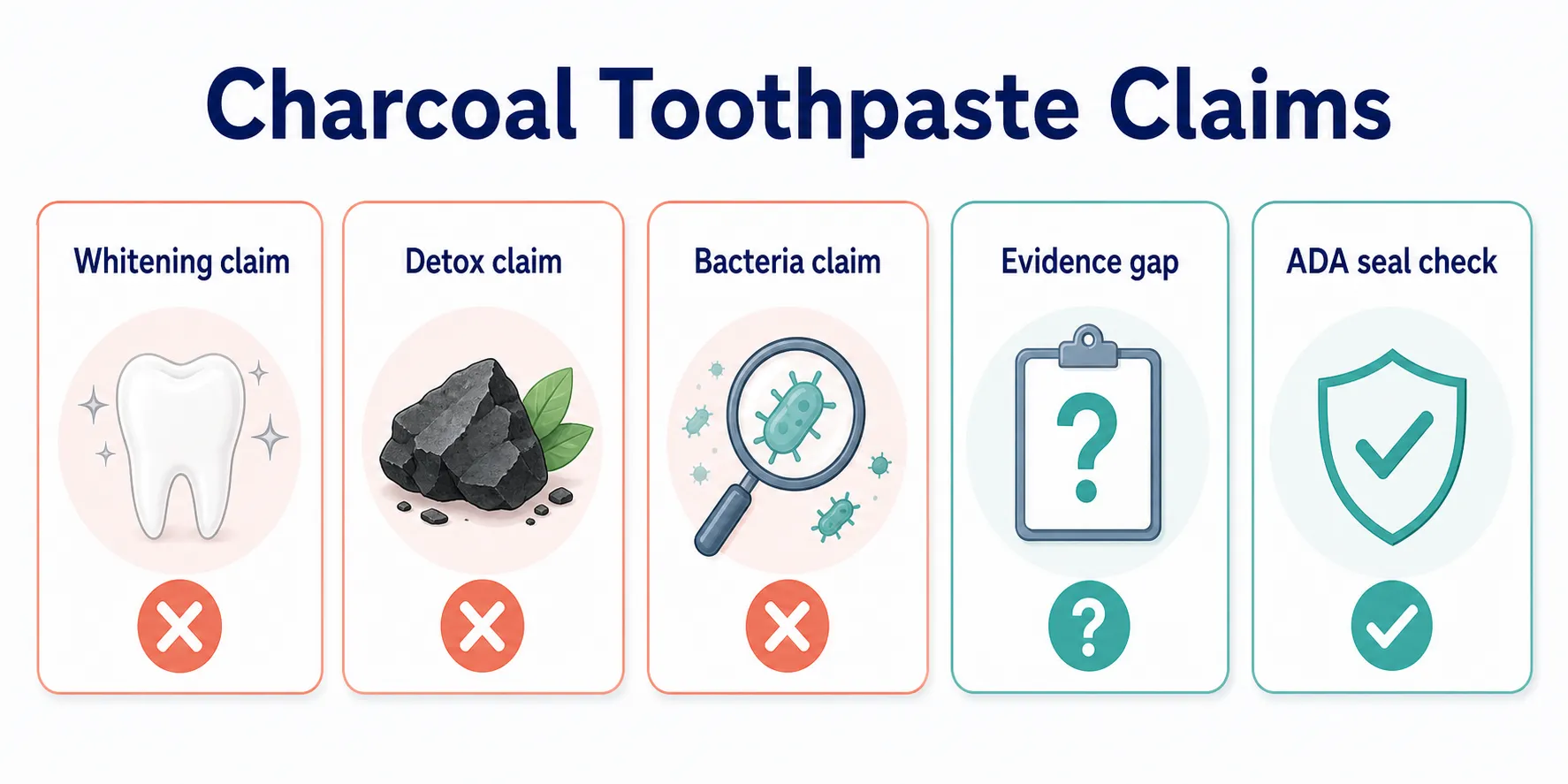
It’s easy to be drawn in by charcoal toothpaste marketing. Labels often promise detoxification, antibacterial protection, and deep whitening. This language may sound both scientific and natural, but the clinical evidence doesn’t support most of these claims. Here are the most common claims and what research actually shows:
- Whitens teeth: No clinical evidence supports meaningful whitening beyond surface abrasion. Multiple systematic reviews find no significant whitening advantage over regular toothpaste.
- Removes toxins: No clinical studies confirm that charcoal detoxifies teeth or saliva in any measurable way.
- Fights bacteria and fungi: Research finds no inhibition of cavity-causing bacteria by charcoal dentifrices. No clinical studies support antibacterial or antifungal claims for charcoal oral products.
- Freshens breath: No controlled clinical evidence supports this claim beyond what any abrasive cleaning would produce.
- Reduces gum inflammation: No clinical evidence supports this claim. The ADA has stated that there is no reliable evidence that charcoal dental products whiten teeth and that they may be unsafe. No charcoal toothpaste has earned the ADA Seal of Acceptance. Before trusting product claims, look for that seal on the label.
Whitening Options That Work
Proven whitening options exist, and several are available without a prescription. The key difference between these and charcoal products is that they work by chemically altering tooth color rather than scrubbing away surface enamel. Most effective OTC and professional whitening options include:
- Whitening toothpastes with the ADA Seal: These use mild polishing agents or low-concentration peroxide to remove surface stains safely and can lighten teeth by about one to two shades.
- Whitening strips and gels: These contain hydrogen peroxide or carbamide peroxide, which penetrate the enamel to reduce intrinsic discoloration. The ADA considers both safe and effective when used as directed.
- Professional in-office whitening: Dentists use higher concentrations of peroxide, sometimes combined with light activation, to achieve faster, more dramatic results than OTC products can deliver.
- Dentist-supervised take-home trays: Custom-fitted trays with prescription-strength peroxide gel offer results between OTC strips and in-office treatment, with more control over concentration and application time. Sensitivity is the most common side effect of peroxide-based whitening. It affects a significant share of users early in treatment but is typically mild and resolves within days. Whitening products do not change the color of crowns, veneers, or fillings, so talk to your dentist before starting any whitening treatment to find the safest option for you.
Preventing Tooth Discoloration
Daily habits make a meaningful difference in preventing tooth staining in the first place. A few simple changes can slow discoloration between cleanings:
- Limit pigmented drinks: Coffee, tea, red wine, and cola are leading causes of surface staining. Drinking these through a straw reduces direct contact with tooth surfaces.
- Rinse after meals: Rinsing your mouth with water after eating or drinking dark-colored foods helps wash away staining compounds before they set.
- Maintain good oral hygiene: Brush twice daily with fluoride toothpaste and floss regularly to remove plaque that can trap stains.
- Schedule regular dental cleanings: Professional cleanings remove surface stains that daily brushing can’t reach and allow your dentist to monitor your enamel health over time.
Talk to Your Dentist
If you want a brighter smile, you have real options that research supports. A dentist can evaluate your enamel health, check existing restorations, and recommend the whitening approach best suited to your teeth. When shopping for any dental product, look for the ADA Seal of Acceptance. This seal means the product has met standards for safety and effectiveness.
Sources
- Brooks et al."Charcoal and charcoal-based dentifrices: A literature review." Journal of the American Dental Association, 2017.
- Tomás et al."Activated charcoal-based toothpastes and their effects on tooth colour: A systematic review." Journal of Dentistry, 2023.
- da Silva DF, Figueiredo FC, Scaramucci T, Mailart MC, Torres CRG, Borges AB. “Is the Whitening Effect of Charcoal-Based Dentifrices Related to Their Abrasive Potential or the Ability of Charcoal to Adsorb Dyes?” Journal of Dentistry, 2024;140:104794.
- Varadan P, Balasubramanian P, Divakar A, Rajendran MR. “Does the Activated Charcoal Tooth Paste Utilization Yield Effects in Dental Whitening in Adult Population: A Systematic Review.” Journal of Dental Specialities, 2025;13(1):10–15.
- Zoller et al."Relative dentin abrasivity and enamel abrasivity of charcoal-containing toothpastes." Clinical Oral Investigations, 2023.
- Machla et al."Abrasivity and fluoride content of charcoal-based toothpastes." Journal of Dentistry, 2020.
- Yaghini J, Moghareabed A, Hatam F, Keshani F. “Effect of Two Types of Charcoal Toothpaste on the Enamel Surface Roughness of Permanent Teeth.” Dental Research Journal, 2023;20:98.
- Panariello et al."Effect of charcoal-based toothpastes on Streptococcus mutans biofilm." Journal of Dentistry, 2020.
- Bauler et al."Characterization of Brazilian charcoal-based dentifrices available on the market." Brazilian Oral Research, 2021.
- Carey, C.M."Tooth whitening: What we now know." Journal of Evidence-Based Dental Practice, 2014.
- American Dental Association.Whitening ADA.org, 2023.

Board-certified general dentist specializing in patient education and preventive dentistry.

Related Articles
Are Teeth Naturally Yellow?
The natural color of teeth tends to range from white to light yellow. This is because of two layers of dental tissue: en...
Does Baking Soda Whiten Teeth?
Does baking soda whiten teeth? Get the facts on baking soda and hydrogen peroxide for whiter teeth, plus the risks and b...
Charcoal Toothbrushes: What Are They & Do They Work?
Are charcoal toothbrushes safe? Find out everything you need to know, including what they are, the science behind them,...

Why Do Coffee and Tea Stain Your Teeth?
Some food and beverages can cause teeth stains. Coffee and tea are common drinks that do this. Read on to find out how t...